How Common Is OCD: Prevalence Stats and What They Mean
If you struggle with repetitive thoughts, you have probably wondered how common is ocd and whether others share your feelings. It is easy to feel completely isolated when dealing with intrusive thoughts or quiet mental rituals. However, epidemiological studies show that millions of people around the globe experience these exact symptoms every single day. To help you understand your patterns, you can explore our free OCD test online. This comprehensive guide will break down global prevalence rates, analyze how symptoms manifest across different demographics, and reveal why many people suffer in silence for years. By looking closely at the statistics, you will find a safe, informative path toward deeper self-reflection.
Is OCD Rare or Common? Worldwide Prevalence Rates
Global OCD Prevalence: The 1-to-2 Percent Reality
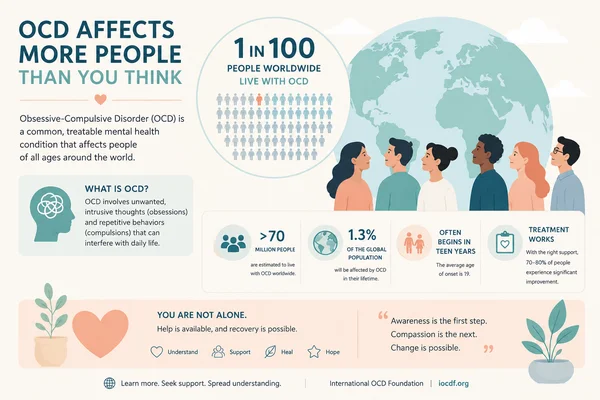
To evaluate whether is ocd rare or common, we must look at global epidemiological studies. Statistically, Obsessive-Compulsive Disorder is not rare at all. The world health organization ocd statistics show that the lifetime ocd prevalence rate sits between 1% and 2% of the global population. This means that up to 160 million people worldwide live with this condition. If you walked into a crowded room of one hundred people, at least one or two would likely understand your struggle. Therefore, you are never truly alone in your experience.
Geographic Trends: Prevalence Rates in America and India
National data also illustrates how widespread these symptoms are across different borders. For example, when examining how common is ocd in america, researchers estimate that about 2.3 million adults live with the condition. Meanwhile, studies focusing on how common is ocd in india report similar prevalence rates, ranging from 1% to 3% in clinical surveys. These numbers prove that cultural and geographical boundaries do not change the core human vulnerability to these obsessive loops. Consequently, researchers gather ocd statistics worldwide to build global support networks.
How OCD Ranks Among Other Mental Health Conditions
It helps to understand how common is ocd in the world by comparing it to other mental health challenges. When analyzing how common is ocd compared to other mental illnesses, it ranks as the fourth most common psychiatric disorder. While it is less prevalent than major depressive disorder or generalized anxiety, it is more common than schizophrenia or bipolar disorder. For this reason, mental health organizations categorize it as a major global health concern. Learning these facts can help reduce the shame you might feel about your symptoms.
OCD Across Demographics: Children, Teens, and Adults

What Age Does OCD Usually Start?
You might wonder, what age does OCD usually start? The onset of symptoms typically follows a bimodal pattern, meaning it peaks at two distinct times in life.
- Peak 1 (Childhood Onset): Symptoms often appear between the ages of 8 and 12, frequently manifesting as extreme worries about germs or a need to arrange toys symmetrically.
- Peak 2 (Adolescent/Young Adult Onset): A larger peak occurs between 18 and 25, often triggered by major life transitions, stress, or academic pressures.
Therefore, the average ocd onset age sits around 19.5 years old. Knowing this timeline helps parents and young adults identify symptoms early, before they disrupt educational or social milestones.
Childhood and Adolescent Onset Patterns
Analyzing how common is ocd in children reveals that it affects roughly 1 in 200 kids. As children grow, the focus of their anxiety often shifts, making us ask how common is ocd in teens. In the teenage years, the prevalence rate rises slightly to about 1% to 2% because hormonal changes and personal expectations can act as triggers. If you noticed your patterns starting in high school, your experience aligns with standard developmental trends.
Gender Dynamics: How Prevalence Shifts from Childhood to Adulthood
When reviewing ocd statistics by gender, we observe a fascinating shift over time. In childhood, the condition affects boys more frequently than girls, with boys often showing earlier symptoms. However, as individuals reach adulthood, this trend reverses completely. Research shows how common is ocd in women, who are statistically more likely than men to develop symptoms in adulthood. Specifically, postpartum hormonal shifts and stress can trigger obsessive thoughts in women. Understanding these gender-specific patterns allows clinicians to offer more tailored support for different life stages.
Prevalence of OCD Subtypes: From "Pure O" to Sensorimotor OCD
The Hidden Frequency of "Pure O" (Purely Obsessional) OCD
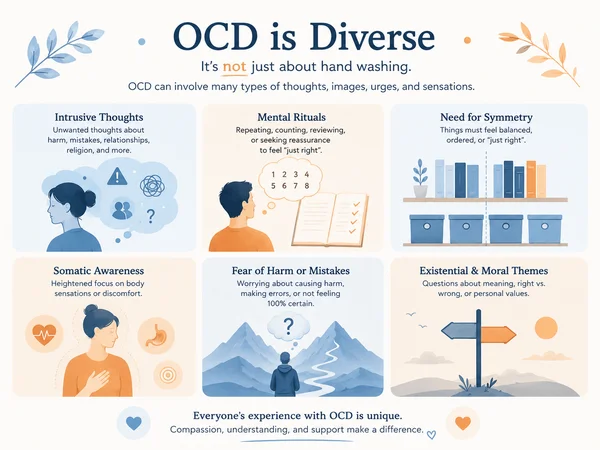
Many people associate OCD only with visible rituals like hand washing. However, researchers are discovering how common is pure o ocd, where compulsions are entirely mental rather than physical. People with "Pure O" experience distressing intrusive thoughts and perform quiet, internal checks to find relief. Because there are no obvious outward behaviors, these individuals often go unnoticed by family members. If you spend hours arguing with your own thoughts in silence, you may be experiencing this highly common, yet invisible, subtype.
Harm and Symmetry Obsessions: Beyond Handwashing
To understand the true scope of the condition, we must look at other distressing patterns. For example, when evaluating how common is harm ocd, studies show that up to 50% of OCD sufferers experience intrusive thoughts about harm. These thoughts involve a sudden, terrifying fear of hurting yourself or someone you love, though you have no desire to do so. Additionally, symmetry obsessions drive a constant need to align items perfectly. Recognizing that these terrifying thoughts are common symptoms, not personal desires, can bring massive relief.
Just Right and Sensorimotor OCD: Sensory-Based Subtypes
Other individuals struggle with sensory-based symptoms, leading us to examine how common is just right ocd. This subtype causes a persistent, uncomfortable feeling that an object or an action is not "just right." You might flip a light switch repeatedly until the physical sensation feels balanced. Similarly, if we look at how common is sensorimotor ocd, we see people becoming hyper-aware of automatic bodily functions like breathing or blinking. Because these sensory-focused loops are highly exhausting, understanding them is the first step toward finding relief.
The Hidden Numbers: Why Many Struggle with Undiagnosed OCD
The 14-Year Diagnostic Gap: Why OCD Often Goes Undetected
Despite clear diagnostic criteria, there is a massive gap between the onset of symptoms and professional confirmation. On average, individuals spend 14 to 17 years living with symptoms before receiving an accurate diagnosis. This delay occurs because many people do not realize their specific fears fit under the OCD umbrella. Also, doctors sometimes misdiagnose the condition as general anxiety or depression. If you have spent years trying to decode your own mind, this systemic delay explains why your journey has felt so long.
Stigma, Silence, and the Rise of Peer Support on Reddit
The deep shame associated with taboo thoughts often forces people into isolation, illustrating why OCD is so hard to live with. Because of this fear of judgment, many individuals turn to anonymous online spaces to find validation. This explains the massive traffic behind queries like how common is ocd reddit, where thousands share their experiences daily. Reading these threads reveals that your most secret, frightening thoughts are actually shared by many others. This anonymous peer support helps break down the stigma, paving the way for safer, more formal self-reflection.
Empowering Your Journey: Moving Beyond the Statistics
While looking at global data provides comfort, your personal experience is what matters most. Understanding your specific ocd symptoms and severity is an active, empowering step toward mental clarity. If you are ready to explore your mental patterns, we invite you to try our free OCD test online. This self-assessment is designed to help you organize your thoughts and clarify what you are experiencing.
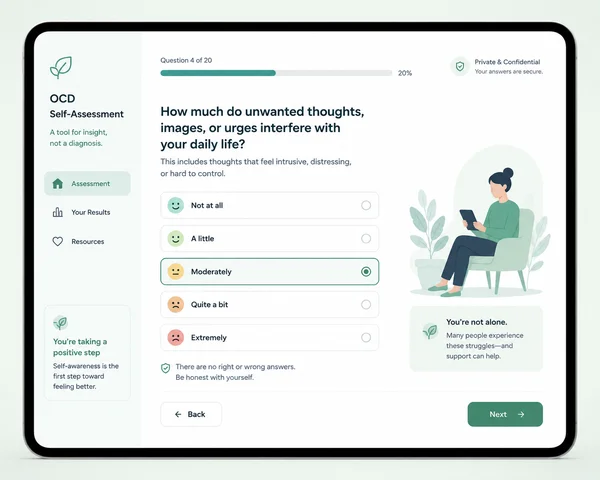
Disclaimer: This online assessment is an educational screening tool, not a clinical diagnostic evaluation. It is designed to foster self-awareness and assist in future conversations with mental health professionals.
By taking this small step, you can transition from worrying in silence to gathering clear, actionable insight.
Navigating Your Path to Understanding and Mental Clarity
As you discover how common is ocd and realize you are part of a global community, the heavy burden of your symptoms can begin to lift. As you continue to learn about this condition, remember that self-awareness is your greatest ally. If you find that intrusive thoughts are starting to interfere with your daily life, it may be time to seek professional support. Licensed therapists can guide you through evidence-based treatments like Exposure and Response Prevention (ERP). To begin mapping out your experiences, you can use our online OCD test as a safe, confidential starting point. Taking charge of your mental health journey is a brave decision, and you do not have to walk this path alone.
Frequently Asked Questions
What is considered severe OCD?
Mental health professionals measure severity based on how much time your symptoms consume and how deeply they disrupt your life. Generally, if your obsessions and compulsions take up more than three hours of your day, your symptoms are considered severe. Severe symptoms can make it incredibly difficult to maintain a job, attend school, or enjoy healthy social relationships.
What happens if OCD is left untreated?
If you leave your symptoms untreated, they can become more deeply ingrained over time. The anxiety-compulsion loop acts like a habit that strengthens every time you perform a ritual. Over time, this loop can shrink your world, making you avoid places, people, or activities that trigger your anxiety. Early intervention is key to breaking this cycle before it limits your life.
What does severe OCD do to the brain?
Neuroimaging studies show that the condition affects specific communication loops in your brain. Specifically, there is hyperactive signaling in the cortico-striato-thalamo-cortical (CSTC) circuit, which manages your safety checks and habit responses. When this circuit is overactive, your brain struggles to send the "all clear" signal, leaving you trapped in a state of high alert.
Is OCD a delusional disorder?
No, it is not a delusional disorder. The main difference lies in a concept called "insight." Most people with OCD possess high insight, meaning they recognize that their obsessive fears are irrational or excessive, even though they feel intensely real. In contrast, someone experiencing a delusional disorder fully believes their irrational thoughts are objectively true.
How do I get out of an OCD loop?
Breaking an obsessive loop requires a systematic approach to changing how you respond to intrusive thoughts:
- Notice the Trigger: Acknowledge the intrusive thought or sensation without trying to fight it or push it away.
- Delay the Response: Commit to waiting at least 5 minutes before performing any physical or mental compulsion.
- Engage Your Senses: Practice the 5-4-3-2-1 grounding exercise to anchor your mind in the physical surroundings of the present moment.
Practicing these short delays consistently over time weakens the brain's automatic urge to perform compulsions.