Is OCD Neurodivergent: Meaning, Overlap, and Support
If you keep typing is OCD neurodivergent into Google, you’re probably trying to name a pattern—not win an argument. The trouble is that different sources use neurodivergent in different ways, so the answers can clash. In this guide, you’ll get a plain-language framework: what neurodivergent means, how OCD patterns work, where OCD can overlap with autism or ADHD, and what to do next without forcing a label. You’ll also get two action tools—a checklist and a few common mistakes to avoid. This article is for education and self-understanding, not diagnosis. If you want a structured way to reflect, you can explore our OCD screener later as an optional step.
What Does Neurodivergent Mean in Plain Language
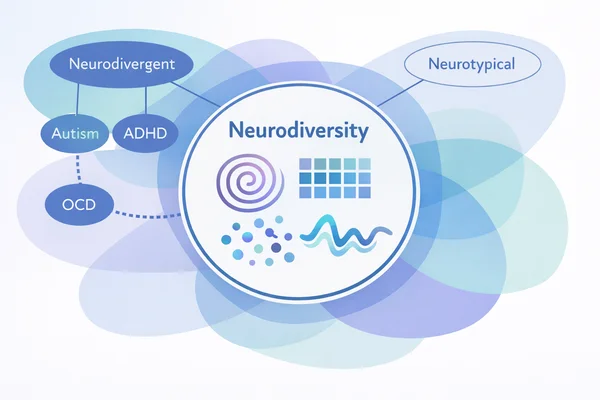
When you ask is OCD neurodivergent, you’re usually asking a practical question: Do I experience the world in a way that feels meaningfully different from most people? That’s a fair question. However, the word neurodivergent changes meaning depending on who’s using it.
Neurodiversity vs Neurodivergent vs Neurotypical
- Neurodiversity: the idea that human brains vary, and variation is normal.
- Neurodivergent: a descriptor for traits that differ from what society treats as typical.
- Neurotypical: a descriptor for traits that align more closely with what’s considered typical.
These words describe patterns. They are not a personal verdict.
A Definition Selector: Community Use vs Clinical Use
Before you decide what counts, pick the frame you’re reading in:
- Community use often treats neurodivergent as an identity lens. It can feel validating and reduce shame.
- Clinical use often treats neurodivergent as a shorthand for neurodevelopmental profiles. In that frame, OCD may be discussed differently.
Neither frame is wrong. But mixing them without noticing creates confusion.
Why Do Sources Disagree on Whether OCD Is Neurodivergent
Most disagreements come from answering different questions. One source treats the phrase as an identity label. Another treats it as a classification question. Once you spot that difference, the debate becomes easier to read, and less personal.
Is OCD Neurodivergent, or Is It a Different Framework
Here’s the short version: OCD is widely recognized as a mental health condition, while neurodivergent is a broader, more flexible descriptor. That’s why people can disagree while still trying to be accurate. You may also see the question phrased as is OCD a form of neurodivergence or is OCD a type of neurodivergence. Those wordings usually point to the same tension: label vs classification.
Why Some People Include OCD Under Neurodivergence
People who say is OCD neurodivergent and answer yes often mean this:
- OCD involves persistent patterns in how you process uncertainty, risk, and responsibility.
- OCD can feel like a brain style, not just a bad habit.
- The label can reduce shame and help you ask for accommodations.
In short, the label can function as a bridge to self-understanding. For many, that’s the point.
Why Others Say It Depends
Others hesitate to answer is OCD neurodivergent with a simple yes, because:
- The term can blur identity language and clinical language.
- OCD can cause intense distress and impairment, and some people worry the label could minimize that.
- Different systems categorize OCD in different ways, and the label debate isn’t settled.
So, it depends is not a dodge. It’s an attempt to stay precise.
A Practical Takeaway: Labels vs. Lived Experience
If the label helps you communicate needs and treat yourself with more compassion, it may be useful. If the label becomes another certainty-seeking loop, it may be better to set it down.
What OCD Patterns and Symptoms Do People Often Misunderstand
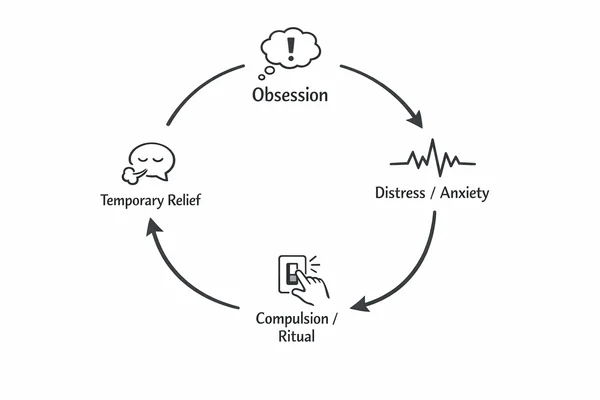
Some people search OCD neurodivergent symptoms because the experience doesn’t match stereotypes. OCD is not just neatness. It is often a loop: a triggering thought or sensation, a spike of distress, and a response that brings short-term relief. Then the doubt returns.
How Obsessions and Compulsions Reinforce Each Other
- Obsessions can include intrusive doubts, images, urges, or what-if fears.
- Compulsions can include actions or mental rituals meant to reduce distress or prevent a feared outcome.
Because the relief is temporary, the brain learns to repeat the ritual. That can feel like your mind won’t let the question go.
Less-Obvious Patterns Like Rumination and Reassurance-Seeking
Not all compulsions look obvious. Some are internal:
- rumination (trying to solve the doubt perfectly),
- reassurance-seeking (asking others, or searching online, to feel certain),
- mental reviewing (scanning memory for proof),
- just-right pressure (trying to neutralize discomfort).
These patterns are common reasons people keep circling the same question.
Why Distress and Uncertainty Matter in OCD
A helpful clue is function. Is the thought pattern trying to remove uncertainty right now? If yes, that may be an OCD-like loop. If it’s impacting your life, it’s worth discussing with a professional.
Is OCD on the Autism Spectrum? Understanding Overlap With Autism and ADHD
This is a top reason people search is OCD neurodivergent: overlap. You might see routines, repetition, fixations, or sensory stress and wonder what it really is. Let’s slow it down.
Is OCD on the Autism Spectrum, or Is That a Misunderstanding
OCD is not on the autism spectrum. Still, OCD and autism can co-occur, and some behaviors can look similar from the outside. That’s why the question returns: is OCD neurodivergent, and does that mean autism?
The safer, clearer answer is: overlap exists, and labels require nuance.
What Can Look Similar in OCD and Autism, but Mean Different Things
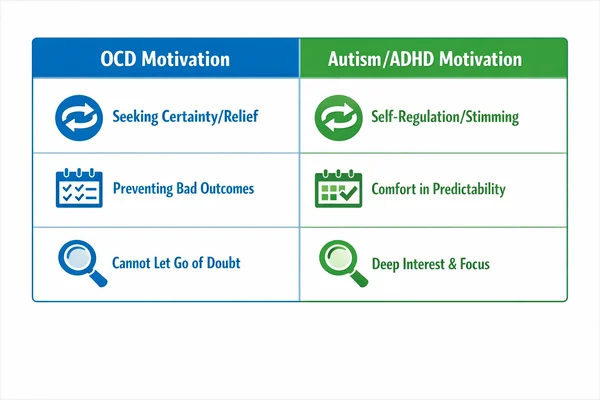
Two people can do the same behavior for different reasons. For example:
- Repeating a phrase
- OCD-like function: to neutralize anxiety or prevent harm
- Autism-related function: to self-regulate, enjoy rhythm, or communicate
- Avoiding certain situations
- OCD-like function: to avoid triggers that provoke doubt
- ADHD/autism-related function: to manage sensory overload or executive strain
So, when you ask is OCD neurodivergent, the key is not the behavior alone. It’s the purpose the behavior serves.
An Overlap vs. Motivation Comparison Table
| What You Notice | Often OCD-Leaning Why | Often Autism/ADHD-Leaning Why |
|---|---|---|
| Repetition | I need certainty or relief | This helps me regulate |
| Checking | I need total certainty | I lose track and need structure |
| Routines | If I don’t, something bad happens | Predictability feels safer |
| Fixation | I can’t let the doubt go | Deep interest and focus |
This table can’t diagnose anything. However, it can help you interpret why is OCD neurodivergent feels like such a hard question.
When It Helps to Seek a Professional Differential Evaluation
Consider professional support if you feel stuck, distressed, or impaired—especially if:
- your day gets hijacked by rituals, rumination, or checking,
- you avoid important parts of life,
- you can’t outthink the fear anymore.
A good clinician helps you map patterns without forcing a single label.
Are You Born With OCD, or Does It Develop Over Time?
If you’re asking is OCD neurodivergent, you may also wonder: Was I born this way? The reality usually looks like a mix of factors. Some people notice OCD patterns early. Others see them intensify later, especially under stress.
Genetics, Environment, and Brain Circuits in Plain Language
Genes can influence risk, but they don’t write your entire story. Environment and learning also matter. If a ritual lowers anxiety once, your brain may want to repeat it. Over time, that learning loop can strengthen.
Why Stress Can Amplify OCD Patterns
Stress doesn’t cause everything. However, stress can amplify patterns that already exist. When you feel unsafe, your brain seeks control. That can increase checking, rumination, or reassurance-seeking.
What Wired Differently Can Mean Without Fatalism
Feeling wired differently can simply mean your mind reacts strongly to uncertainty and learns relief behaviors quickly. That can change with skills, support, and practice.
Is OCD a Mental Illness or Neurodivergent
People often treat is OCD neurodivergent like a binary quiz: either mental illness or neurodivergent. But language doesn’t work that neatly.
Here’s a grounded way to hold both:
- Clinical language helps with treatment planning, insurance systems, and professional communication.
- Identity language helps with self-compassion, community, and practical accommodations.
So, you can acknowledge OCD as a mental health condition and still relate to neurodivergent language if it helps. If the label increases shame, though, it isn’t serving you.
What Should You Do Next Without Self-Diagnosing
If you’re reading this because is OCD neurodivergent won’t leave your head, you deserve a next step that doesn’t turn into another compulsion. Here are two action tools you can use today.
Self-Reflection vs. Screening vs. Clinical Assessment
Use this quick guide:
- Self-reflection: helps you name patterns and triggers
- Good for: clarity, journaling, conversations
- Screening tools: help you organize symptoms and see clusters
- Good for: structured reflection, what should I ask about?
- Clinical assessment: a professional evaluation in context
- Good for: diagnosis, treatment planning, tailored support
A screening tool should not confirm anything. Instead, it supports the same goal behind is OCD neurodivergent: making sense of your experience.
If You Relate to OCD Patterns, What Are Safe Next Steps?
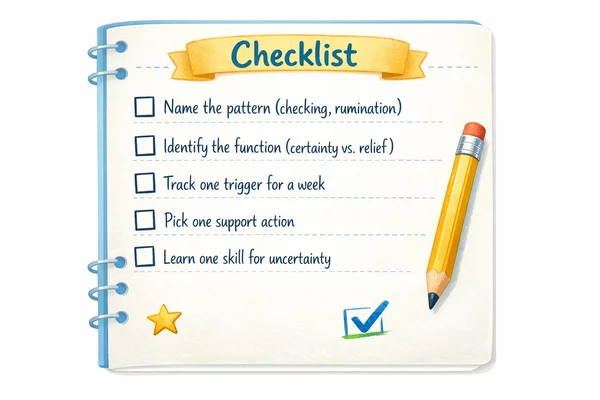
Step-by-step Next Steps Checklist
- Name the pattern you notice (checking, rumination, reassurance, just right).
- Notice the function: are you seeking certainty or relief?
- Track one trigger for a week (no over-analysis, just notes).
- Pick one support action: talk to someone you trust or a professional.
- Learn one skill that targets uncertainty tolerance (small steps work).
If you feel overwhelmed, simplify the list. Even one step helps.
What Evidence-Based OCD Help Typically Focuses On
Many approaches focus on reducing the power of rituals and building tolerance for uncertainty. In practice, that often means learning how to notice urges, pause, and choose a different response. If you want help, you can ask a professional about OCD-focused therapy and what it typically targets.
How an OCD Screener Can Help You Organize Your Next Step
At this point, you may still be asking is OCD neurodivergent, but with a new question behind it: What patterns do I actually have? That’s where a gentle, educational screener can help.
Why Structure Helps When You Feel Stuck
When anxiety runs high, your mind wants certainty. It wants a final answer. Structure gives you something safer: a map. A map won’t solve everything. However, it can stop the endless loop of is OCD neurodivergent and move you toward practical clarity.
Introducing the Ocdtest.net Screener: Educational and Private
If you want a structured way to explore, you can try our free OCD screening tool. It’s designed for education and self-reflection. It is not a diagnosis, and it can’t replace professional care.
What You Can Learn From Your Results Without Over-Interpreting
A helpful screener can:
- highlight symptom clusters you relate to,
- give you language for what you’re experiencing,
- help you decide what questions to bring to a professional.
It should not be used to prove anything. If you notice yourself using it as reassurance, pause and return to the Next Steps checklist above.
How to Use Results Responsibly as Notes, Not a Verdict
Try this simple method:
- Write down 3 statements that feel accurate.
- Write down 2 situations where the pattern shows up.
- Write down 1 question you want help answering.
Then stop. That stopping point matters. It keeps the tool supportive, not compulsive.
Your Next Steps After Reading Is OCD Neurodivergent
If you came here asking is OCD neurodivergent, you now have a clearer way to think about it. First, definitions vary, so disagreement is normal. Next, overlap exists, but motivations matter. Finally, you don’t need a perfect label to take a healthy next step.
If you feel distressed, stuck, or limited by these patterns, consider professional support. And if you want a low-pressure way to organize what you’re noticing, you can explore our free OCD screening tool as an educational starting point—not a diagnosis.
Frequently Asked Questions
Does OCD count as neurodiversity?
Sometimes people include OCD in neurodiversity discussions, especially in community spaces. However, others use a narrower definition. So when you ask is OCD neurodivergent, the count depends on the definition being used.
What disorders fall under neurodivergent?
There isn’t one universal list. Some people use neurodivergent mainly for neurodevelopmental differences. Others use it more broadly. If you’re asking is OCD neurodivergent, it can help to ask, Which definition is this source using?
Is OCD on the autism spectrum?
No—OCD is not on the autism spectrum. Still, OCD and autism can overlap or co-occur. That’s why is OCD neurodivergent can feel tied to autism questions, even when they are not the same thing.
Is OCD genetic?
Genes can influence risk, but genetics don’t act like destiny. Many factors shape how OCD patterns appear and change. So is OCD neurodivergent can connect to genetics, but it doesn’t reduce to one cause.
Are you born with OCD, or does it develop?
Some people notice OCD patterns early, while others develop stronger symptoms later. Stress can also amplify patterns. If is OCD neurodivergent feels urgent, focus on what’s happening now and what support helps.
Is OCD neurodivergent or a mental illness?
Mental illness is a clinical category. Neurodivergent is a broader label that varies by context. So is OCD neurodivergent depends on whether you’re using identity language, clinical language, or both.
Can you be neurotypical and still have OCD?
Yes. Neurotypical and neurodivergent labels do not function as diagnostic gates. If you keep asking is OCD neurodivergent, you may be looking for a single label—but your lived experience matters more than the label.