Obsession vs Compulsion: Meaning, Examples, and the OCD Cycle
If you are trying to understand obsession vs compulsion, the simplest starting point is this: an obsession is the unwanted mental trigger, and a compulsion is the response a person feels driven to do. In OCD, the two often form a loop. A thought, image, urge, doubt, or "what if" feeling creates distress. Then a behavior or mental ritual promises relief, certainty, or prevention. The relief may feel real for a moment, but it usually does not last. For a private first step, an OCD self-reflection tool can help you look at patterns without treating the result as a formal evaluation.

Obsession and Compulsion Meaning in Plain English
An obsession is not the same as liking something a lot. In everyday speech, people may say they are obsessed with a show, a hobby, or a person. In OCD language, an obsession is usually unwanted, repetitive, intrusive, and upsetting. It may arrive as a thought, mental picture, urge, question, memory, or body sensation that feels hard to dismiss.
A compulsion is a repeated behavior or mental act done to reduce distress, prevent a feared outcome, undo a thought, or gain certainty. Compulsions can be visible, such as washing, checking, arranging, repeating, or asking for reassurance. They can also be private mental rituals, such as reviewing memories, counting silently, praying in a rigid way, replacing a "bad" thought with a "good" one, or scanning your feelings for certainty.
The key difference is function. An obsession creates alarm. A compulsion tries to neutralize the alarm. The content can vary widely, but the pattern often feels familiar: "What if something is wrong?" followed by "I need to do something until I feel sure."
Obsession vs Compulsion Examples
Examples are useful because OCD is often misunderstood as only cleaning or organizing. Obsessions and compulsions can involve contamination, harm, mistakes, relationships, morality, health, symmetry, identity, or responsibility.
| Theme | Obsession | Possible compulsion |
|---|---|---|
| Contamination | "What if this surface makes me sick?" | Washing, avoiding, disinfecting, or changing clothes repeatedly |
| Harm | "What if I accidentally hurt someone?" | Checking appliances, hiding objects, retracing steps, seeking reassurance |
| Responsibility | "What if I forgot something important?" | Re-reading, saving items, checking messages, reviewing decisions |
| Symmetry or "just right" | "This feels wrong unless it is even." | Arranging, tapping, repeating movements, restarting tasks |
| Moral or religious fear | "What if that thought means I am bad?" | Confessing, praying repetitively, mental reviewing, asking for reassurance |
| Relationship doubt | "What if I do not love my partner enough?" | Comparing feelings, testing attraction, researching, asking others |
These examples do not prove that a person has OCD. The concern rises when the pattern is unwanted, repetitive, time-consuming, distressing, or starts interfering with school, work, relationships, sleep, parenting, faith, or ordinary daily choices.
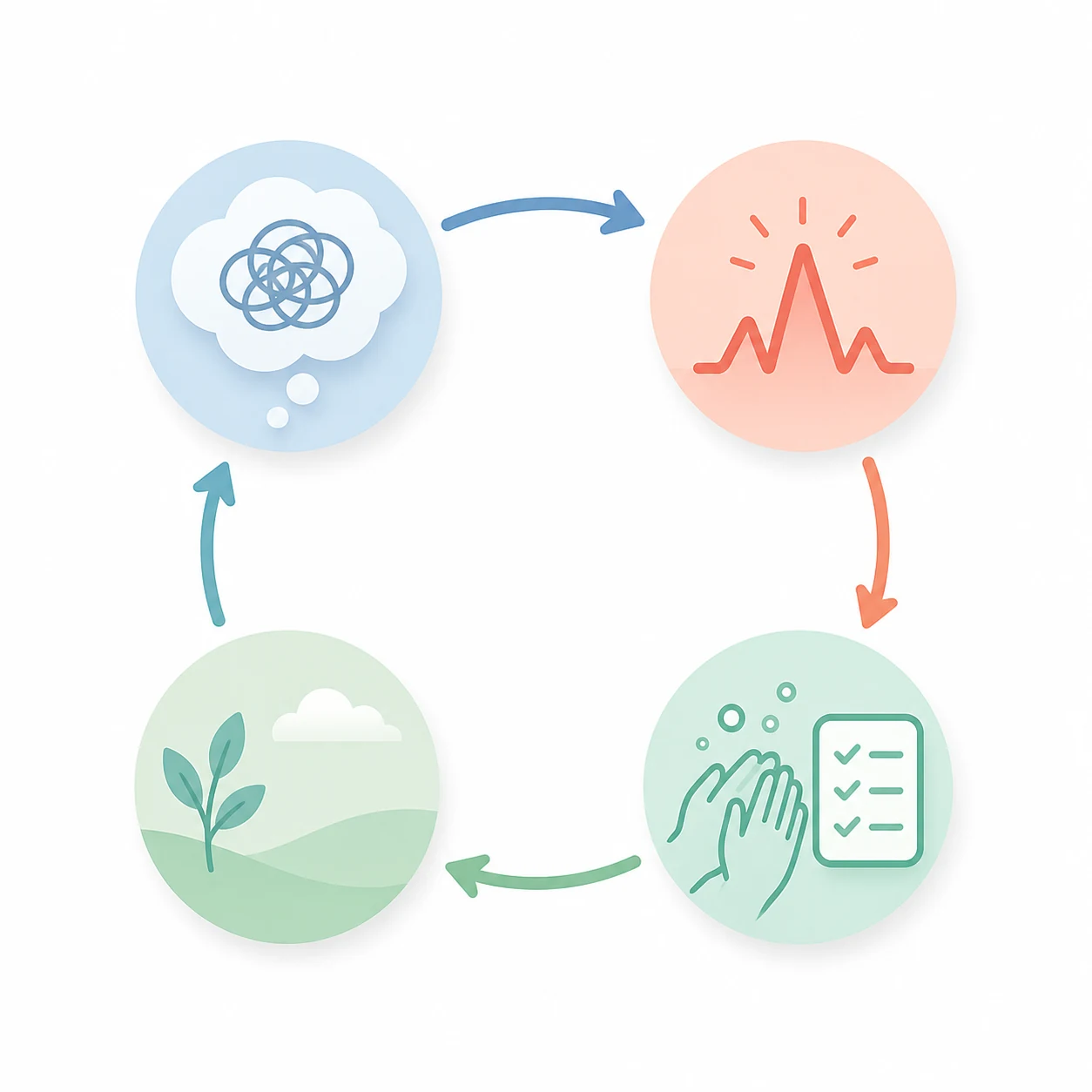
How Obsessions and Compulsions Work Together in OCD
In the OCD cycle, compulsions are understandable. They are attempts to feel safe, certain, clean, morally okay, or prepared. The problem is that the ritual often teaches the brain that the obsession was dangerous and that relief depends on doing the ritual again. This can make the next obsession feel more urgent.
For example, a person may think, "What if I left the stove on?" Checking once may be practical. Checking five, ten, or twenty times, returning home after leaving, or replaying the stove in memory until it feels "right" may become compulsive if distress keeps demanding certainty.
Another person may have an intrusive image that clashes with their values. They may analyze why it appeared, search for reassurance, test whether they felt anxiety, or repeat a phrase to cancel it. From the outside, nothing may look unusual. Internally, hours may go into a mental loop.
This is why a gentle OCD pattern screening resource can be useful for reflection. It can help you notice whether the issue is mainly thoughts, visible behaviors, mental rituals, avoidance, reassurance seeking, or a mixture. It should not replace professional support when symptoms are intense, confusing, or disruptive.
Can You Be Compulsive but Not Obsessive?
Yes, but the meaning depends on context. People can have habits, routines, personality traits, addictions, tics, or body-focused repetitive behaviors that look "compulsive" in a broad sense without being OCD compulsions. Someone may check their calendar often because their job requires precision. Another person may repeat a bedtime routine because it is comforting and functional. Those behaviors are not automatically OCD.
In OCD, the compulsion is usually tied to distress, doubt, prevention, neutralizing, or the pursuit of certainty. The person often feels driven to do it even when part of them knows it is excessive or unhelpful.
There can also be obsessions without obvious outward compulsions. This is sometimes informally called Pure O, although many people with this pattern still have mental compulsions: reviewing memories, comparing feelings, praying silently, counting, seeking reassurance, avoiding triggers, or researching whether a thought "means something."
Compulsion vs Addiction: What Is Different?
Compulsion and addiction can overlap in everyday language, but they are not the same idea. A compulsion in OCD is usually performed to reduce anxiety, prevent a feared outcome, or neutralize distress. It often feels unwanted and repetitive, and the relief is usually brief.
Addiction generally centers on continued use of a substance or behavior despite harm, often involving craving, reward, tolerance, withdrawal, or loss of control. A behavior can feel driven in both cases, but the internal engine may be different. OCD compulsions are more often about escaping uncertainty or fear. Addictive patterns are more often about reward, craving, emotional escape, or physiological dependence.
This distinction matters because support needs may differ. Repeated checking may call for OCD-focused support such as exposure and response prevention. Addiction concerns may call for addiction-specific care, medical support, peer support, or a combined plan.
Obsession vs Love, Interest, or Everyday Worry
"Obsession vs love" is a common search because the word obsession gets used casually in relationships. Love usually includes care, respect, flexibility, and the ability to tolerate ordinary uncertainty. An OCD-style obsession about love may feel like urgent doubt that demands checking: "Do I feel enough?", "What if I am with the wrong person?", or "What if this one feeling proves everything?"
An interest or passion can be intense without being an OCD obsession. OCD obsessions tend to feel intrusive, repetitive, unwanted, and distressing. They may push you to perform rituals, avoid people or places, or keep searching for a final answer that never stays final.
Everyday worry is also different. A normal worry may respond to practical problem-solving. An obsession often returns even after reasonable reassurance. It may demand perfect certainty about something that no person can fully prove.
OCD vs OCPD and Other Common Mix-Ups
OCD and OCPD are often confused. OCD usually involves intrusive obsessions and compulsions that cause distress or feel out of line with the person's values. OCPD is a personality pattern involving rigidity, control, perfectionism, and orderliness that may feel more like "the right way" to the person. Someone can have traits of both, but they are not the same condition.
"Obsession vs Backrooms" appears in search data because people may be looking for a game, story world, or internet reference rather than mental health information. If that is your intent, the word obsession is being used in a pop culture or interest-based way. This article focuses on the mental health meaning, especially as it relates to OCD.
Intrusive thoughts can also appear with anxiety, depression, trauma, stress, or other experiences. Labels are less useful than the pattern: Is the thought unwanted? Does it create distress? Do you feel driven to neutralize it? Does the response make life smaller?
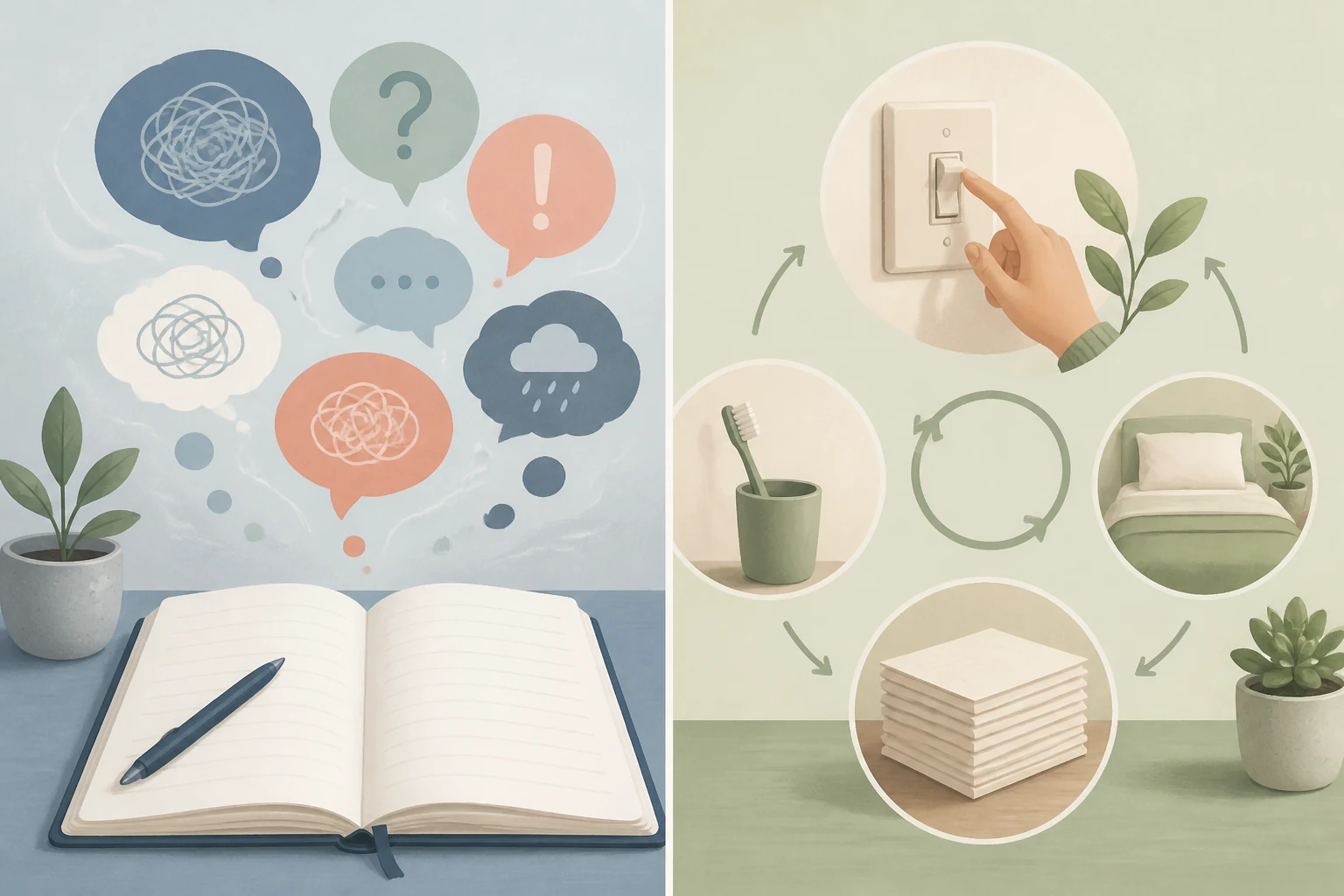
A Simple Way to Reflect on Your Own Pattern
If you are unsure whether something is an obsession, a compulsion, or both, try writing down one recent loop in three parts:
- Trigger: What thought, image, urge, doubt, sensation, or situation started the distress?
- Meaning: What did your mind say the trigger might prove or cause?
- Response: What did you do, avoid, check, repeat, review, confess, research, or ask to feel better?
Then add two notes: how long the relief lasted, and whether the response made the next loop stronger or weaker. This exercise is a way to bring shape to something that can feel messy and private.
You may also ask whether the behavior matches your values or mainly helps you escape uncertainty. Washing your hands after using the bathroom is practical hygiene. Washing until your skin hurts because doubt still feels unresolved may be a different pattern. Reviewing a message once can be ordinary care. Reviewing for an hour may point to a loop worth discussing.
When to Consider More Support
Consider reaching out to a qualified mental health professional if obsessions or compulsions take significant time, cause strong distress, lead to avoidance, strain relationships, interfere with responsibilities, or make your world feel smaller. Support can help you sort through OCD, anxiety, OCPD traits, addiction concerns, trauma responses, or other factors.
Evidence-based OCD care often includes cognitive behavioral therapy with exposure and response prevention, sometimes alongside medication or other supports. The goal is not to erase every doubt. It is often to change the relationship with uncertainty, reduce rituals, and rebuild daily life around values instead of fear.
If you want a low-pressure first step, you can review your symptoms with a private OCD screening starting point. Use the result as educational information and a conversation aid, not as a final answer. If you feel at risk of harming yourself or someone else, seek urgent local support right away.

FAQ
What is the main difference between an obsession and a compulsion?
An obsession is an unwanted intrusive thought, image, urge, doubt, or feeling that creates distress. A compulsion is a repeated behavior or mental act done to reduce that distress, prevent a feared outcome, or gain certainty. In OCD, they often feed each other.
What does an OCD obsession feel like?
It often feels sticky, urgent, unwanted, and emotionally charged. The thought may clash with your values, but it still demands attention. Many people describe the feeling as "I know this may not make sense, but I cannot let it go."
Can you be compulsive but not obsessive?
Yes. Some repeated behaviors come from habits, preferences, work demands, addiction, tics, or other patterns. In OCD, compulsions are usually tied to distress, doubt, neutralizing, avoidance, or a need for certainty. The function of the behavior matters.
What are some examples of obsessions and compulsions in OCD?
Common examples include contamination fears with washing, harm fears with checking, moral fears with confessing or reviewing, relationship doubts with reassurance seeking, and symmetry fears with arranging or repeating. Mental rituals can count as compulsions too.
Are there two types of obsession?
There are many possible obsession themes rather than only two types. Helpful broad groupings include intrusive thoughts, images, urges, doubts, memories, and "just right" feelings. Themes can involve contamination, harm, morality, identity, relationships, health, or responsibility.
Is obsession the same as love?
No. Love usually includes care, respect, flexibility, and room for uncertainty. An OCD-style obsession about love tends to feel intrusive, distressing, and driven by repeated checking or reassurance seeking. Intense interest or affection alone is not OCD.
How is compulsion different from addiction?
An OCD compulsion is usually an attempt to reduce anxiety or neutralize a feared possibility. Addiction often involves craving, reward, tolerance, withdrawal, or continued use despite harm. Some people experience both, so professional support can be helpful when the pattern is unclear.
Can an online OCD screening tool replace professional help?
No. Online screening can support self-reflection and help you organize what you are noticing, but it cannot replace a comprehensive evaluation by a qualified mental health professional. Use it as a starting point, especially if symptoms are distressing or disruptive.