OCD Episode: Symptoms, Triggers, Length, and What to Do
An OCD episode is a period when obsessive thoughts, urges, images, or compulsive behaviors feel more frequent, sticky, or disruptive than usual. Some people call it an OCD flare-up, spike, or attack. Whatever word you use, the experience can be unsettling: you may feel pushed to check, clean, repeat, ask for reassurance, review memories, or avoid ordinary situations just to get a moment of relief. This guide explains what an OCD episode can look like, what may trigger it, how long it may last, and what to do in a grounded way. If you are trying to understand your own patterns, a private OCD self-screening tool can be a gentle first step for reflection.

What an OCD Episode Means
An OCD episode is not a separate condition. It is a noticeable rise in OCD-related distress or rituals. For one person, that might mean contamination fears become hard to dismiss after touching a public surface. For another, it might mean harm-related intrusive thoughts show up repeatedly and lead to mental checking. Someone else may experience relationship doubts, moral fears, symmetry urges, or a need to repeat a phrase until it feels "right."
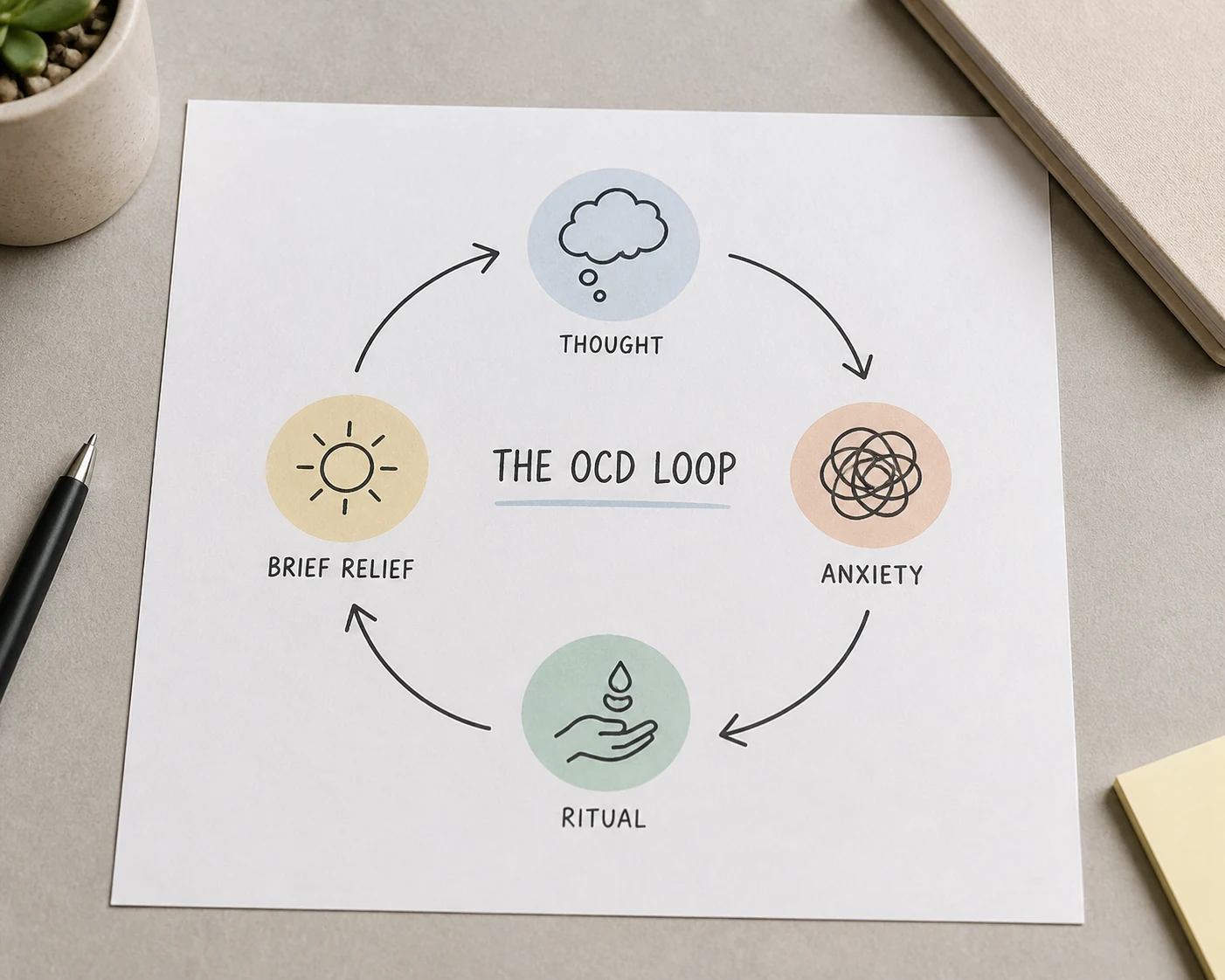
The key pattern is the loop: an intrusive obsession creates anxiety or uncertainty, and a compulsion promises relief. The compulsion may be visible, such as washing, checking, arranging, or repeating. It may also be internal, such as replaying a memory, scanning your body for feelings, silently praying, counting, neutralizing thoughts, or searching online for certainty. Relief often arrives briefly, then the doubt returns and asks for another ritual.
Because OCD varies, an episode can be obvious or almost completely hidden. A person may look calm while spending hours in mental review, or seem withdrawn because their attention is consumed by rules and doubts.
OCD Episode Symptoms: What It Can Look Like
OCD episode symptoms usually involve a change in intensity, time, or control. You may notice that obsessions feel more urgent, compulsions take longer, or avoidance spreads into more parts of daily life.
Common signs include:
- Intrusive thoughts, images, or urges that feel unwanted and hard to move past
- Strong uncertainty about safety, morality, contamination, relationships, identity, or responsibility
- Repeated checking, cleaning, counting, arranging, confessing, comparing, or reassurance seeking
- Mental rituals, such as reviewing, neutralizing, praying, or trying to force a "good" thought
- Avoidance of places, people, objects, decisions, or media that might trigger the loop
- Trouble concentrating because the same question keeps returning
- Temporary relief after a ritual, followed by another wave of doubt
- Distress or lost time that interferes with work, school, sleep, relationships, or basic routines
An OCD episode can also feel physical. Anxiety may bring a racing heart, stomach tension, restlessness, sweating, a feeling of pressure in the chest, or an urge to escape. Those sensations do not prove that the feared thought is meaningful. They may simply show that your nervous system is highly activated.
OCD Episode Triggers and Why Spikes Happen
OCD episode triggers are not always dramatic. Stress can make symptoms louder, but many people also flare during ordinary transitions: starting a job, moving, changing routines, dating, traveling, preparing for exams, or waiting on uncertain news. Poor sleep, illness, conflict, hormonal shifts, grief, and unstructured time can also make intrusive thoughts harder to shrug off.
Triggers may be external, such as touching a doorknob, driving, using a knife, reading upsetting news, or seeing something that violates your sense of order. They may also be internal, such as a random image, a body sensation, a memory, a feeling of doubt, or the absence of the "right" feeling.
One confusing part of OCD is that avoidance can shrink life while appearing to help. If you avoid every trigger, you may feel calmer today, but your brain may learn that the avoided thing was dangerous. That can make the next episode easier to spark. This is why many evidence-based OCD approaches focus on changing the response to uncertainty, not proving every fear false.
OCD Episode Length: Hours, Days, or Months?
There is no universal OCD episode length. A spike may last minutes or hours if the trigger passes and the person can return attention to ordinary tasks. A more intense flare-up may last days or weeks, especially when sleep, stress, reassurance seeking, or avoidance keep the loop active. Some people search for "ocd episode lasting months" because symptoms have settled into a longer season of distress.
When an episode lasts a long time, it does not mean you failed or that nothing can change. It often means the loop has become reinforced: the obsession appears, the ritual reduces distress briefly, and the brain asks for the ritual again. The longer this pattern runs, the more helpful it may be to get support from a qualified mental health professional who understands OCD.
It can help to separate "episode length" from "OCD as a condition." OCD symptoms can wax and wane. They may quiet for a while, then worsen during stress or transition. Timing alone does not tell the whole story. The bigger question is how much time, distress, avoidance, and impairment the loop is creating.
What to Do During an OCD Episode
During an OCD episode, the goal is not to win an argument with every intrusive thought. The goal is to respond in a way that reduces the power of the cycle over time.
Start with a simple label: "This feels like an OCD spike." The label is not a verdict. It is a way to create a little space between you and the urge. Then try to slow the next ritual. You might delay checking for five minutes, wash once instead of repeating, write down the trigger without researching it, or let a doubt remain unanswered while you do one ordinary task.
Grounding can also help you stay present without turning into another ritual. Notice five things you can see, four things you can feel, three sounds, two smells, and one taste. Keep it brief and practical. If you repeat it until it feels perfect, it can become part of the loop.
If you use self-reflection tools, keep the purpose narrow. A brief OCD symptom checker can help you organize what you are noticing, but it should not become a repeated certainty-seeking habit. Use any questionnaire as a snapshot, not a courtroom.
Consider these low-pressure steps:
- Write the trigger, obsession, compulsion, and consequence in one sentence each
- Postpone reassurance seeking instead of banning it forever
- Return to a valued action, even while uncertainty is present
- Reduce online searching when it becomes repetitive
- Share the pattern with a therapist, doctor, or trusted support person
- Seek urgent help if you may harm yourself or someone else, or if you cannot stay safe

An OCD Episode Example
Imagine someone who has checking-related OCD. Before leaving home, they lock the door. A thought appears: "What if it did not latch?" They check once and feel brief relief. Halfway down the stairs, a new doubt appears: "What if I only imagined checking?" They return and check again. At work, they ask a roommate to verify it and replay the moment in their mind.
The problem is not that locking a door is unreasonable. The problem is that certainty becomes the target, and certainty keeps moving. The episode grows because each check teaches the brain that the doubt deserved another ritual.
Another person may have mainly mental compulsions. A taboo intrusive thought appears during dinner. They silently review whether they wanted the thought, compare it with past memories, search for emotional proof, and try to replace it with a neutral image. No one else sees the ritual, but the person is exhausted by the effort.
These examples are not meant to sort everyone into a type. They show how different themes can share the same engine: intrusive uncertainty, distress, a ritual, short relief, and another demand for certainty.
When an OCD Episode Lasts for Months
If an OCD episode lasts for months, think in terms of support, not shame. Longer flare-ups often involve several maintaining factors: repeated reassurance, avoidance, sleep disruption, stress, isolation, and fear of telling anyone what the thoughts are about. Silence can make the episode feel even more powerful.
Professional support can make the pattern less lonely and more workable. Exposure and response prevention, often called ERP, is a well-known OCD-focused form of cognitive behavioral therapy. In ERP, a trained clinician helps a person face triggers gradually while reducing compulsive responses. Medication may also be discussed with a prescriber for some people. The right path depends on the person, their history, and their current safety and functioning.
If you are preparing to talk with a professional, bring concrete notes rather than trying to explain everything perfectly. Useful details include the main obsession themes, visible and mental rituals, avoidance patterns, time spent each day, sleep changes, and what you have already tried.

Use the Pattern as a Starting Point
An OCD episode can feel like a sudden storm, but it is also information. It may show which themes are sticky, which rituals promise relief, and which situations have started to shrink your life. You do not need to solve all of that in one night. A useful next step can be as small as naming the loop, reducing one compulsion slightly, and writing down what changed afterward.
For some readers, the next step is education. For others, it is making an appointment, telling a trusted person, or gathering notes for a therapist. If you want a private way to organize what you are noticing before that conversation, you can explore a free OCD reflection tool and use the results as personal notes rather than a final answer.
FAQ
What is an OCD episode?
An OCD episode is a period when obsessions, compulsions, avoidance, or mental rituals become more intense, frequent, or disruptive than usual. It may also be called a flare-up, spike, or attack. The exact form depends on the person's OCD themes and coping patterns.
What is an OCD flare-up like?
An OCD flare-up often feels like a surge of uncertainty and urgency. A thought, image, urge, or sensation may feel impossible to ignore, and the person may feel driven to check, clean, repeat, confess, review, avoid, or seek reassurance. Relief may come briefly, then fade.
How long does an OCD attack last?
There is no fixed timeline. A spike may last minutes or hours, while a larger flare-up may last days, weeks, or longer. Duration depends on stress, sleep, triggers, compulsions, avoidance, support, and treatment history. If symptoms are taking significant time or limiting life, professional guidance can help.
Does OCD come in episodes?
OCD can wax and wane. Some people have steady symptoms with occasional spikes. Others have quieter periods followed by flare-ups during stress, uncertainty, illness, or major life changes. Episodes do not make the experience less real; they describe a change in intensity.
What do OCD meltdowns look like?
People use "meltdown" in different ways. In OCD, it may mean crying, panic, shutdown, anger, repeated rituals, or feeling unable to move on from a feared thought. It can also be quiet and internal. If someone is overwhelmed, calm support and reduced reassurance loops are usually more helpful than criticism.
What should I avoid during an OCD episode?
Try to avoid turning every doubt into an investigation. Repeated reassurance, checking, online searching, confession, and avoidance can all keep the loop alive. The aim is not perfection; it is to practice a different response one small step at a time.
When should I seek professional help for OCD episodes?
Consider reaching out when symptoms take more than an hour a day, cause intense distress, disrupt sleep, work, school, relationships, or daily routines, or lead to unsafe coping. A qualified mental health professional can evaluate your symptoms and discuss evidence-based options.