Is OCD an Anxiety Disorder? The DSM-5 Change & Key Differences
You feel a constant, humming tension in your chest. Your mind races with "what if" scenarios that refuse to shut off. It feels exactly like high-functioning anxiety, yet there is something else — a need to perform specific rituals or check things repeatedly to make the feeling stop. This leads to a very common question: is OCD an anxiety disorder, or is it something entirely different?
Technically, the answer is no — at least, not anymore. However, the reality of living with these conditions is much more nuanced than a medical label. While Obsessive-Compulsive Disorder (OCD) shares many symptoms with anxiety, understanding the specific differences is crucial for finding the right support.
In this guide, we will break down the medical classification, compare the distinct symptom patterns, and help you determine if you should explore our ocd test online to gain better insight into your experiences.
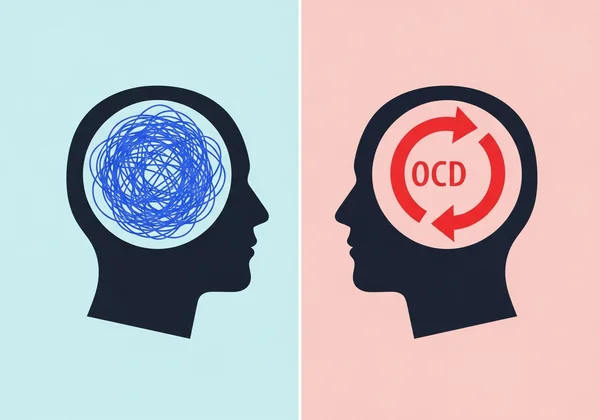
The Short Answer: Is OCD Considered an Anxiety Disorder?
For many years, the medical community grouped OCD under the umbrella of anxiety disorders. If you were diagnosed before 2013, your doctor likely explained it this way. However, our understanding of the brain has evolved.
From DSM-IV to DSM-5: The Shift to Related Disorders
The Diagnostic and Statistical Manual of Mental Disorders (DSM) is the handbook healthcare professionals use to diagnose mental health conditions.
- In the DSM-IV (published in 1994): OCD was listed as an Anxiety Disorder, alongside Generalized Anxiety Disorder (GAD) and Panic Disorder.
- In the DSM-5 (published in 2013): OCD was moved into its own new category called "Obsessive-Compulsive and Related Disorders."
This change was significant. It signaled that while fear and panic are major components of OCD, the condition has unique features — specifically the compulsive rituals — that separate it from standard anxiety.
Why Was OCD Reclassified?
You might wonder, why is OCD no longer considered an anxiety disorder if it causes so much stress?
The reclassification happened because the core "driver" of the behavior is different. In anxiety disorders, the primary driver is usually the emotional response of fear or worry about future events. The person avoids the situation to escape the fear.
In OCD, however, the driver is often a feeling of "incompleteness" or a need for things to be "just right," combined with intrusive thoughts. The person doesn't just avoid the fear; they perform active, repetitive behaviors (compulsions) to neutralize the thought. Because the brain circuitry involved in these rituals differs from the circuitry involved in pure fear, experts felt it deserved its own category.
OCD vs. Generalized Anxiety: Identifying the Distinct Patterns
Knowing the medical definition is helpful, but it doesn't always help you figure out what is happening in your own head on a Tuesday night. To truly understand the difference between OCD and anxiety, we need to look at the patterns of your thoughts and reactions.
Comparing the Thought Process (Intrusive vs. Worries)
Both conditions involve overthinking, but the content of the thoughts usually differs.
Generalized Anxiety (GAD):
- Real-world Focus: Thoughts usually revolve around real-life concerns like money, health, job performance, or family safety.
- Excessive Logic: The thoughts are rational but blown out of proportion. For example, "If I lose my job, I’ll lose my house."
- Ego-Syntonic: These thoughts align with your self-view. You view them as valid concerns, just too intense.
OCD:
- Bizarre or Magical: Thoughts are often unrelated to real-life logic. For example, "If I don't tap this table three times, my mom will get into a car crash."
- Intrusive Nature: The thoughts pop up out of nowhere and feel shocking or disgusting.
- Ego-Dystonic: The thoughts do not align with your values. A loving parent might have an intrusive thought about harming their child, which terrifies them.
Comparing the Reaction (Rituals vs. Safety Behaviors)
How do you react when the anxiety spikes?
- Anxiety Reaction: You tend to worry, over-prepare, or seek reassurance. You might avoid the stressful situation entirely (e.g., calling in sick to avoid a presentation).
- OCD Reaction: You perform a specific ritual to "fix" the feeling. This could be physical (washing hands, checking locks) or mental (counting, repeating a phrase). The goal isn't just to avoid the situation, but to prevent a specific bad outcome through a ritual.
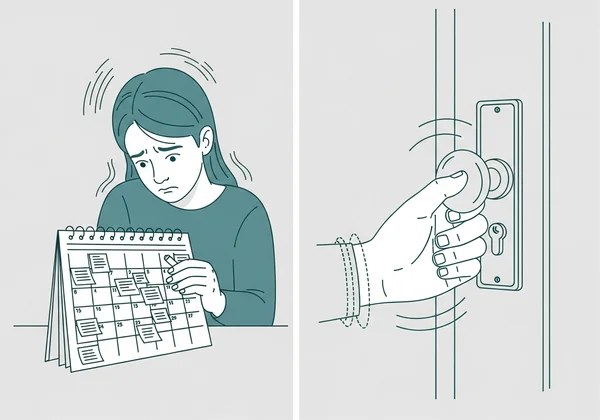
Real-Life Scenarios: How They React Differently
To make this concrete, let's look at how someone with GAD versus someone with OCD might handle the same scenario.
| Scenario | Generalized Anxiety Reaction | OCD Reaction |
|---|---|---|
| Leaving the House | You worry you might be late or that you forgot to turn off the stove. You check the stove once, maybe twice, just to be safe, but you eventually leave feeling uneasy. | You have an intrusive thought that the house will burn down if the knobs aren't at 12 o'clock. You touch each knob four times in a specific rhythm. If you get interrupted, you must start over. |
| Physical Health | You worry about getting sick during flu season. You wash your hands often and take vitamins. You worry about the consequence of being sick (missing work). | You feel "contaminated" after touching a doorknob. You must wash your hands for exactly 20 seconds using hot water. The fear is less about missing work and more about the feeling of contamination. |
| Driving | You feel tense and hyper-alert. You worry about other drivers hitting you. You might avoid highways because they feel dangerous. | You hit a bump and possessive thoughts tell you that you hit a pedestrian. You circle the block five times to check for a body, even though you saw nothing. |
Why does the distinction between OCD and anxiety matter?
Distinguishing between OCD vs anxiety is not just about semantics; it determines the treatment plan.
If you treat OCD with standard talk therapy (CBT) that focuses on "rationalizing" the fear, it often fails. You cannot logic your way out of an irrational OCD ritual. OCD usually requires Exposure and Response Prevention (ERP) therapy, where you face the fear without doing the ritual.
Conversely, Generalized Anxiety often responds very well to CBT, relaxation techniques, and mindfulness, which might not be aggressive enough for severe OCD.
Unsure Where You Stand? How to Find Clarity
Reading about symptoms is an important first step. However, when you are in the middle of a high-stress episode, your brain can play tricks on you. You might read about OCD and think, "I check the door sometimes, do I have it?" or read about anxiety and think, "I worry about money, is that it?"
Why Self-Diagnosis Can Be Confusing
It is difficult to be objective about your own mind. We all have "intrusive thoughts" occasionally, and we all have moments of fixation. The difference lies in the frequency, the distress caused, and how much it interferes with your daily life.
Because the symptoms overlap so heavily, relying solely on checklists can sometimes lead to more confusion or "Medical Student Syndrome"—where you feel you have every condition you read about.
Using an Educational Screening Tool
One effective way to cut through the noise is to use a structured screening tool. These tools are not diagnoses, but they act as a mirror, reflecting your symptom patterns back to you objectively.
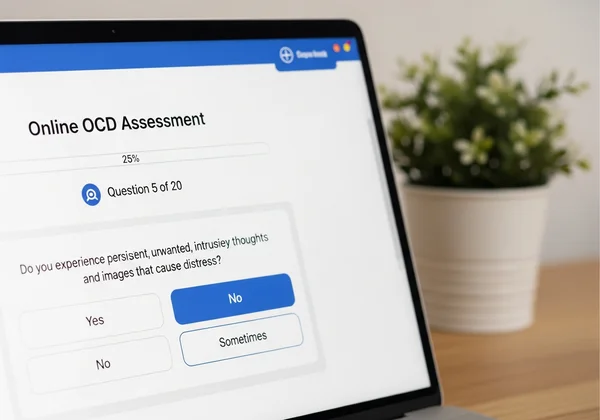
If the scenarios above resonated with you, but you aren't quite sure where you fit, you can try the ocd test on our platform.
This tool is designed to look beyond just "worry" and identify the specific cycle of obsessions and compulsions. It is free, anonymous, and can provide a baseline for understanding your mental landscape before you speak to a professional.
Can You Have Both OCD and Anxiety? (The Comorbidity Factor)
Perhaps you read the comparison section and thought, "I do both of those things."
This is incredibly common. Can you have both OCD and anxiety? Absolutely. In clinical terms, this is called comorbidity. In fact, studies suggest that a large percentage of people with OCD also meet the criteria for an anxiety disorder like GAD or Panic Disorder.
The "Venn Diagram" of Symptoms
Imagine a Venn diagram.
- Circle A (OCD): Rituals, magical thinking, intrusive images.
- Circle B (Anxiety): Excessive worry about future, physical tension, avoidance.
- The Overlap: Restlessness, difficulty sleeping, difficulty concentrating, need for reassurance, and stomach issues.
If you live in the overlap, your nervous system is likely in a constant state of high alert.
Does Anxiety Cause OCD?
Anxiety does not typically "cause" OCD, but it is fuel for the fire.
If you have a genetic predisposition for OCD, a period of high stress or severe anxiety can trigger the onset of symptoms. When your general anxiety levels are high, your brain is less capable of dismissing intrusive thoughts. A thought that you might normally shrug off suddenly feels "sticky" and dangerous, leading you to develop compulsions to manage that anxiety.
Moving Forward with Understanding
So, is OCD an anxiety disorder? The DSM-5 says no, but your lived experience might say "it sure feels like one."
The label matters less than the solution. Whether you are dealing with the broad worries of GAD, the specific rituals of OCD, or a mix of both, the distress you feel is valid. You are not "crazy," and you are not broken. You are dealing with a nervous system that is trying very hard — perhaps too hard — to keep you safe.
Recovery starts with naming the problem accurately. If you are ready to take that first step toward clarity, take a moment to check your traits with this ocd test. It serves as a helpful starting point for your journey toward relief and recovery.
Frequently Asked Questions
Is OCD considered neurodivergent?
Yes, OCD is increasingly considered a form of neurodivergence. This means the OCD brain processes information, thoughts, and sensory input differently than a "neurotypical" brain, similar to ADHD or Autism.
Is rumination a sign of OCD or anxiety?
It can be both. However, anxiety rumination is usually about solving real-life problems (e.g., replaying a conversation to see if you offended someone). OCD rumination often involves solving unanswerable philosophical questions or checking your own feelings (e.g., "Do I really love my partner?").
Is OCD a mood disorder?
No. Mood disorders, such as Major Depressive Disorder or Bipolar Disorder, primarily affect your emotional state (mood). OCD is characterized by the cycle of obsessions and compulsions. However, depression is a common comorbidity with OCD.
Can anxiety trigger OCD symptoms?
Yes. Stress and high anxiety lower your mental defenses. When you are anxious, you are more likely to latch onto intrusive thoughts and perform rituals to self-soothe, which can make OCD symptoms flare up.
What if I have symptoms of both?
If you have symptoms of both, a mental health professional will typically assess which condition is causing the most impairment in your daily life and target that one first. Often, treating the OCD via ERP will naturally lower general anxiety levels.