OCD Treatment Guide: ERP & How to Treat OCD
Have you recently explored your symptoms, perhaps with an online screening tool, and found yourself asking, "What happens now?" Understanding the signs of Obsessive-Compulsive Disorder (OCD) is a brave and crucial first step. But the journey doesn't end there. Learning about effective OCD treatment is how you'll begin managing the condition, regaining control, and improving your quality of life.
This guide breaks down the most effective, science-backed therapies for OCD, helping you take control of your journey. We will focus on the gold-standard approach, Exposure and Response Prevention (ERP), and explore other methods to help you navigate your next steps with confidence. If you're just starting and want to better understand your own patterns, a confidential OCD test can provide a helpful foundation for this journey.

Understanding OCD Treatment: Core Principles & Effectiveness
To make informed decisions about your OCD care, let's first explore what truly makes a treatment effective. Not all approaches are created equal, and knowing the difference can empower you to find the help that truly works.
What Makes an OCD Treatment "Evidence-Based"?
You will often hear the term "evidence-based" when discussing OCD treatment. This simply means that the therapy has been rigorously tested in scientific studies and has been proven to be effective for a large number of people. It’s not based on theory or guesswork; it’s backed by data and research.
For OCD, this is particularly important because the condition has a very specific cycle of obsessions and compulsions. Evidence-based treatments like ERP are designed to directly target and break that cycle. Choosing this path ensures you are investing your time and energy in a method with a high probability of success.
Setting Expectations: Can OCD Be Cured, or Is It Managed?
This is one of the most common and important questions people ask. The most accurate way to think about OCD is as a chronic condition that is highly manageable. While there may not be a "cure" in the sense that it disappears forever without any effort, recovery is absolutely possible.
Think of it like managing a condition such as asthma or diabetes. With the right tools, strategies, and support, you can learn to control your symptoms so they no longer interfere with your ability to live a full, meaningful life. The goal of OCD treatment is not to eliminate all unwanted thoughts—everyone has those—but to change your relationship with them so they no longer hold power over you.
Exposure and Response Prevention (ERP): A Detailed Guide
When it comes to evidence-based care for OCD, one treatment stands above all others: Exposure and Response Prevention (ERP). It is considered the first-line psychological treatment for OCD due to its high success rate. While it can sound intimidating, understanding how it works can help demystify the process.
How ERP Works: Breaking the Cycle of Obsessions and Compulsions
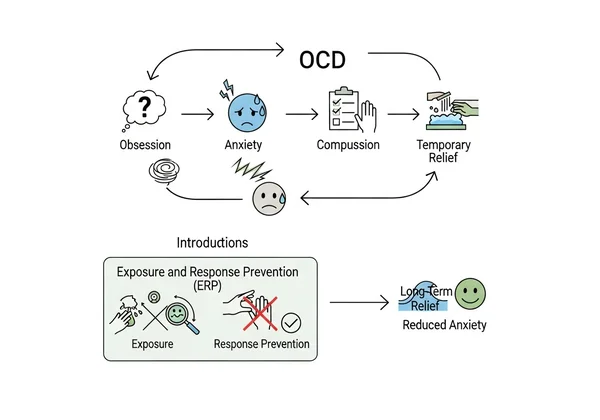
OCD thrives on a vicious cycle:
- Obsession: An intrusive, unwanted thought, image, or urge causes intense anxiety or distress. (e.g., "My hands are contaminated with germs.")
- Anxiety: The obsession triggers feelings of fear, disgust, or dread.
- Compulsion: You perform a ritual or behavior to reduce the anxiety. (e.g., Washing your hands for ten minutes.)
- Relief: The compulsion provides temporary relief, but it reinforces the belief that the compulsion is necessary to prevent a bad outcome.
ERP works by breaking this cycle systematically. It has two key components: exposure and response prevention.
- Exposure: You will gradually and safely confront the thoughts, situations, or objects that trigger your obsessions and anxiety.
- Response Prevention: You will make a conscious choice not to engage in the compulsive behavior you would normally use to seek relief.
By staying in anxiety-provoking situations without performing rituals, you teach your brain something important. The anxiety will naturally decrease on its own, and the feared outcome you dread won't happen.
What to Expect During ERP Therapy Sessions
ERP is not about throwing you into your worst fear on day one. It is a carefully planned and collaborative process guided by a trained therapist. Here’s what you can generally expect:
- Assessment: Your therapist will work with you to understand your specific obsessions and compulsions.
- Building a Hierarchy: Together, you will create a list of your triggers, ranking them from mildly anxiety-provoking to severely distressing.
- Gradual Exposures: You will start with exposures from the lower end of your hierarchy. For example, if you have contamination fears, you might start by touching a "clean" doorknob and then resisting the urge to wash your hands for a set amount of time.
- Moving Up: As you build confidence and your anxiety decreases, you will gradually move up the hierarchy to face more challenging triggers. Your therapist will support you at every step.
Overcoming Challenges and Maximizing Your ERP Success
There is no sugarcoating it: ERP is hard work. It requires courage and commitment. However, it is also incredibly empowering. To maximize your success, remember to:
- Be Patient with Yourself: Progress isn't always linear. There will be good days and tough days.
- Trust the Process: Your brain will fight back, telling you that you need to do the compulsion. Leaning into the discomfort is part of the healing process.
- Communicate Openly: Be honest with your therapist about your fears and challenges. They are your partner in this journey.
- Practice Consistently: Completing ERP "homework" between sessions is essential for making lasting progress.
Exploring Other Effective OCD Therapy Approaches
While ERP is the gold standard, it is often used alongside other effective strategies. A comprehensive OCD treatment plan may include different elements tailored to your specific needs.
Cognitive Behavioral Therapy (CBT) and Its Role in OCD
ERP is actually a specific type of Cognitive Behavioral Therapy (CBT). Broader CBT techniques can also play a supportive role. The "Cognitive" part focuses on identifying and challenging the distorted thinking patterns that fuel OCD.
For example, a therapist might help you challenge cognitive distortions like "thought-action fusion"—the belief that simply having a thought is as morally wrong as acting on it. By learning to see your obsessive thoughts as just "brain noise" rather than dangerous facts, you can reduce their power.
The Role of Medication in OCD Management
For some individuals, medication can be a very helpful part of an OCD treatment plan. The most commonly prescribed medications for OCD are a class of antidepressants called Selective Serotonin Reuptake Inhibitors (SSRIs).
Medication doesn't "cure" OCD, but it can help reduce the intensity of obsessions and the urge to perform compulsions. This can lower your overall anxiety levels, making it easier to engage in and benefit from therapy like ERP. A discussion with a medical doctor or psychiatrist is necessary to determine if medication is right for you.
Finding a Qualified Therapist for OCD
Finding the right professional is one of the most critical steps. When looking for a therapist, you should specifically seek someone who specializes in OCD and has training in Exposure and Response Prevention (ERP).
Don't be afraid to ask potential therapists questions about their experience and approach. Ask them directly: "Do you specialize in OCD?" and "What is your experience with using ERP?" A qualified professional will be happy to answer these questions. Finding a good fit is key, as the therapeutic relationship is a cornerstone of successful treatment. To get a better sense of your own symptoms before speaking with a professional, you might consider taking a free OCD test.

Your Next Steps Towards Understanding and Managing OCD
Your decision to learn about OCD treatments shows your commitment to taking control of your mental health journey. Remember that OCD is a highly manageable condition, and with the right support, you can significantly improve your quality of life. The journey begins with understanding, moves forward with evidence-based action like ERP, and is sustained by professional guidance.
Your path to managing OCD is unique, but it doesn't have to be walked alone. Understanding your starting point is powerful. If you're still exploring what you're experiencing, our confidential self-assessment can be an insightful first step on your path toward seeking professional help. You have the power to change your relationship with OCD, and your journey starts today.
Frequently Asked Questions About OCD Treatment
How do I know if ERP is the right treatment for my OCD?
ERP is considered the "gold-standard" psychological treatment for OCD because of its high success rate in clinical trials. It is recommended as the first-line therapy for most people. A qualified therapist specializing in OCD will conduct a thorough assessment. This helps confirm your diagnosis and determine if ERP is the best fit for your specific symptoms and circumstances.
Can I really test myself for OCD, and then what?
Online screening tools can be a valuable first step in your journey. They can help you organize your thoughts and better understand your symptoms. However, they are not a substitute for a professional diagnosis. The results from an online OCD test can be a helpful starting point. You can use them to have a productive conversation with a doctor or therapist, who can then provide an accurate diagnosis and treatment plan.
What are the common side effects of OCD medication?
Like any medication, SSRIs used for OCD can have side effects. These may include nausea, headaches, or difficulty sleeping, especially when first starting. For many people, these side effects are mild and decrease over time. It is crucial to discuss any potential side effects with your prescribing doctor, who can help you manage them or adjust your treatment.
How can I support a loved one going through OCD treatment?
Supporting someone with OCD can be challenging, but your role is vital. The best things you can do are to educate yourself about OCD and ERP, offer patience and encouragement, and celebrate their progress. It's also important not to participate in their rituals or provide excessive reassurance, as this can unintentionally strengthen the OCD cycle. Encouraging them to stick with their therapy is one of the most supportive actions you can take.