OCD vs Perfectionism: When to Test
Do you find yourself double-checking your work until it's flawless? Or perhaps you spend hours rearranging items until they feel just right? Many people pride themselves on having high standards, but sometimes these habits can cause significant distress. It's a common point of confusion: Am I just a perfectionist, or are these signs of something more, like Obsessive-Compulsive Disorder (OCD)?
Getting clear on whether you're dealing with perfectionism or OCD can bring immediate relief and set you on the right path. Perfectionism can sometimes be a healthy driver of success. OCD, however, is a mental health condition characterized by a distressing cycle of obsessions and compulsions. This guide will help you clearly distinguish between the two.
We'll explore the core motivations, behaviors, and impacts of both. By the end, you'll have a better understanding of where your tendencies fall. If you recognize patterns that feel closer to OCD, our confidential OCD test can provide a starting point for deeper insight.

Understanding OCD and Perfectionism Distinctions
To tell the difference between OCD and perfectionism, we first need to understand what each one is. While they can look similar on the surface—both can involve a strong desire for order and correctness—their underlying roots are fundamentally different. Knowing these distinctions is crucial for self-awareness.
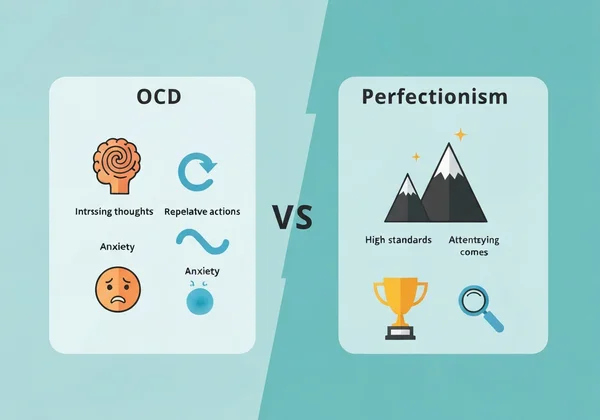
Perfectionism is generally considered a personality trait, characterized by striving for flawlessness and setting excessively high performance standards. In contrast, OCD is a clinical diagnosis defined by the presence of obsessions and compulsions that cause significant impairment.
Diagnostic Criteria: What Makes OCD Different?
OCD is defined by two key components: obsessions and compulsions. Obsessions are intrusive, unwanted thoughts, images, or urges. They cause intense anxiety and distress. People with OCD don't want these thoughts and typically find them disturbing.
Compulsions are repetitive behaviors or mental acts that a person feels driven to perform in response to an obsession. The goal of the compulsion is to reduce the anxiety caused by the obsession or to prevent a feared event from happening. However, this relief is only temporary, and the cycle soon repeats. For an OCD diagnosis, this cycle must be time-consuming (taking more than an hour per day) OR cause significant distress. It must also impair functioning in social, occupational, or other important areas.
The Spectrum of Perfectionism: Healthy Habits vs Compulsive Behaviors
Perfectionism exists on a spectrum. On one end, there is adaptive or healthy perfectionism. This involves setting high personal standards and working diligently to achieve them. It is driven by a desire for excellence and can lead to great achievements and a sense of satisfaction. A healthy perfectionist can usually adjust their standards when needed and move on from mistakes without excessive self-criticism.
On the other end is maladaptive or unhealthy perfectionism. This form is driven by a fear of failure and negative evaluation from others. A maladaptive perfectionist often feels that their work is never good enough, leading to procrastination, anxiety, and burnout. While this can cause distress, it is still different from OCD unless it is accompanied by true obsessions and compulsions.
Real-Life Examples: OCD vs Perfectionism in Daily Situations
Let's look at a common scenario: arranging books on a shelf.
-
A Healthy Perfectionist: Might spend 20 minutes arranging their books alphabetically or by color because they enjoy the look of an organized shelf. They feel a sense of accomplishment when it's done and can tolerate it if a book is later misplaced.
-
An Unhealthy Perfectionist: May spend over an hour arranging the books, feeling intense frustration if they can't get the alignment perfectly even. They might worry that a visitor would judge them for a messy shelf. They feel stressed during the process but are driven by achieving a flawless outcome.
-
A Person with OCD: May feel compelled to arrange the books in a very specific, rigid order. This isn't driven by a desire for a neat shelf, but by an intrusive thought (obsession) that if the books aren't perfectly symmetrical, something terrible might happen to a loved one. The arranging (compulsion) is a ritual to neutralize this fear. The process brings no pleasure, only temporary relief from overwhelming anxiety.

Key Differences Between OCD and Perfectionism
Now that we have a foundational understanding, let's break down the three most critical differences that separate perfectionist tendencies from OCD symptoms. Paying attention to these areas can offer significant clues about what you might be experiencing.
If these distinctions start to resonate with your personal struggles, it may be helpful to get a clearer picture. You can always start your test to gain more personalized insights based on your specific experiences.
Motivation: Inner Distress vs External Standards
The "why" behind the behavior is perhaps the biggest clue.
- Perfectionism is typically driven by a desire to achieve the best possible outcome or to meet high external or internal standards. The motivation is often about success, praise, or avoiding criticism. A student might rewrite an essay ten times to get an A+. The goal is positive achievement.
- OCD, on the other hand, is driven by the need to reduce profound anxiety and distress stemming from an obsession. The motivation is not to achieve something positive but to prevent something negative or to get rid of a terrifying thought. The person performing the compulsion often knows it's illogical but feels powerless to stop.
Flexibility: When Can You Stop? The Compulsion Threshold
Another key difference is the ability to be flexible and decide when a task is "good enough."
- A perfectionist, even an unhealthy one, usually has some level of control. They might spend an excessive amount of time on a project, but they can eventually decide to stop, even if reluctantly. Their standards are high, but they can be negotiated, especially when faced with a deadline.
- For a person with OCD, the compulsion is not a choice. It feels like an urgent, non-negotiable demand. They cannot simply "decide" to stop. The feeling is that they must complete the ritual until it feels "just right" or the anxiety subsides. This threshold is internal and often feels magical or arbitrary, rather than being based on objective quality.
Impact on Daily Life: Functionality vs Impairment
Finally, consider how these traits affect your overall quality of life.
- Healthy perfectionism often enhances life. It can lead to professional success, academic achievement, and personal satisfaction. Even unhealthy perfectionism, while stressful, may not completely derail a person's ability to function at work, school, or in relationships.
- OCD, by definition, causes significant impairment. The obsessions and compulsions consume time, drain mental energy, and interfere with daily routines, relationships, and responsibilities. The goal is no longer to do something well, but simply to cope with the mental torment. It feels like a prison, not a pursuit of excellence.
When Perfectionism Might Indicate OCD
Many people with OCD are also perfectionists, and it can be difficult to see where one ends and the other begins. However, there are clear warning signs that your perfectionistic tendencies may have crossed over into the realm of OCD. Recognizing these red flags is an important step toward seeking the right kind of support.
If you read through the following points and find them uncomfortably familiar, it might be a sign that your struggles go beyond simple perfectionism. An initial screening can be a helpful tool for clarity.
Red Flag Behaviors: When Self-Correction Becomes Obsessive
Think about your "correcting" behaviors. A perfectionist might proofread an email three times to catch typos. Someone with OCD might feel compelled to delete and retype a word dozens of times because an intrusive thought became attached to it. The behavior is no longer about quality control; it has become a ritual to neutralize anxiety. Other red flags include repetitive checking (locks, stove, appliances) far beyond what is reasonable, or an inability to move on from a task because of a persistent feeling that something is wrong.
Emotional Distress: Anxiety That Goes Beyond Normal Concerns
While a perfectionist might feel stressed about a deadline, the anxiety in OCD is on a different level. It is often intense, overwhelming, and feels catastrophic. The fear is not just about getting a bad grade, but about being responsible for a disaster. For example, a perfectionist worries about making a mistake at work. A person with harm OCD might have an intrusive thought of hurting someone and feel compelled to perform a ritual to ensure they don't. The emotional weight of this distress is a significant indicator of OCD.
Time Investment: When Minutes Turn into Hours
Consider the amount of time you spend on these behaviors. A perfectionist might dedicate extra time to a project they care about. But if you find that your "perfectionistic" routines are consistently consuming more than an hour of your day, every day, it's a major red flag. When routines to ensure cleanliness, order, or correctness begin to dominate your schedule and prevent you from doing other things you need or want to do, it's a strong sign that these behaviors are compulsive, not just meticulous. If this sounds like you, it may be time to take our free tool for a preliminary check.
Take the First Step Toward Clarity
Telling the difference between perfectionism and OCD isn't just semantics—it can change how you approach and manage these challenges. Perfectionism, even when unhealthy, is rooted in a desire for high achievement. OCD, however, is a clinical condition driven by a distressing cycle of intrusive thoughts and compulsive rituals aimed at neutralizing anxiety. The key differences lie in the motivation behind the actions, the flexibility to stop, and the overall impact on your daily life.
Understanding where you stand is the first and most empowering step you can take. It replaces confusion with knowledge and allows you to consider the right path forward. Remember, you are not alone in this feeling, and gaining insight is a sign of strength.
If you recognize patterns of inner distress, rigid compulsions, and significant life impairment in your perfectionistic tendencies, clarity is within reach. We encourage you to take our free, confidential OCD test to gain scientifically-backed insights into your symptoms and learn about potential next steps.

Frequently Asked Questions About OCD vs Perfectionism
Can perfectionism turn into OCD?
Perfectionism itself is a personality trait and does not "turn into" OCD, which is a neurobiological condition. However, having maladaptive perfectionism can be a risk factor for developing OCD, especially if you are genetically predisposed. The intense self-criticism and anxiety associated with perfectionism can create a fertile ground for obsessions and compulsions to take root.
How do I know if my perfectionism is healthy?
Healthy perfectionism is flexible, driven by a desire for excellence, and leads to satisfaction. Ask yourself: Can I move on from mistakes? Do I enjoy the process of striving for my goals? Am I able to prioritize and decide when something is "good enough"? If the answer is generally yes, your perfectionism is likely adaptive. If it's driven by fear, causes constant stress, and you can't stop, it may be maladaptive.
Will the OCD test confirm if I have OCD?
Our online test is a preliminary screening tool, not a diagnostic instrument. It is designed based on scientific principles to help you identify the presence and severity of common OCD symptoms. The results can provide valuable personal insights and serve as a helpful starting point for a conversation with a qualified mental health professional, who is the only one who can provide an official diagnosis.
What if I'm still unsure after reading this?
It's completely normal to feel unsure, as these concepts can be complex and overlapping. If you remain concerned about your thoughts and behaviors, taking an initial step can help. Using a structured tool like our online OCD test can give you a more objective look at your symptoms, which can be less confusing than trying to figure it all out on your own.
Can a perfectionist benefit from OCD treatment approaches?
Yes, absolutely. Many therapeutic approaches used for OCD, such as Cognitive Behavioral Therapy (CBT), can be very effective for managing maladaptive perfectionism. These therapies help individuals challenge rigid thinking patterns, reduce black-and-white thinking, and learn to tolerate imperfection and uncertainty. This can lead to a significant reduction in anxiety and an improved quality of life.