Psychiatric Evaluation: What It Involves and How to Prepare
If you have been struggling with persistent sadness, overwhelming anxiety, intrusive thoughts, or behavioral changes, a psychiatric evaluation may be the right next step. This professional assessment helps identify what you are experiencing and opens the door to effective treatment. Yet the idea of being evaluated can feel intimidating — especially if you do not know what to expect. This guide explains the entire psychiatric evaluation process, from who performs it to what questions you will face and how much it may cost. You will also find a preparation checklist and common pitfalls to avoid. If you want to start reflecting on patterns like intrusive thoughts or repetitive behaviors, an online self-screening can be a helpful first step.

What Is a Psychiatric Evaluation?
A psychiatric evaluation is a comprehensive assessment conducted by a licensed mental health professional. Its purpose is to understand your emotional, behavioral, and cognitive patterns — and to determine whether you meet the criteria for a mental health condition.
Unlike a routine checkup, this evaluation goes deeper. It examines your thoughts, feelings, daily functioning, personal history, and family background. The clinician uses this information, along with diagnostic frameworks like the DSM-5-TR, to reach an accurate understanding of your situation.
A psychiatric evaluation can help with:
- Identifying conditions such as depression, anxiety, OCD, ADHD, bipolar disorder, or PTSD
- Ruling out physical health issues that mimic mental health symptoms
- Creating a personalized treatment plan (therapy, medication, lifestyle changes, or a combination)
- Establishing a baseline for tracking progress over time
- Assessing risk and determining the appropriate level of care
A psychiatric evaluation is not a judgment. It is a clinical process designed to understand your experiences and guide you toward the right support.
Who Performs a Psychiatric Evaluation?
Several types of licensed mental health professionals can conduct a psychiatric evaluation. Each brings different training and specialties.
Psychiatrists
Psychiatrists are medical doctors (MDs or DOs) who specialize in mental health. They can diagnose conditions, prescribe medication, and provide therapy. Because of their medical training, they are uniquely positioned to evaluate how physical health may influence mental well-being.
Psychologists
Psychologists hold doctoral degrees (PhD or PsyD) and specialize in psychological testing, talk therapy, and behavioral analysis. They perform comprehensive diagnostic evaluations but typically cannot prescribe medication (with a few state-level exceptions).
Psychiatric Nurse Practitioners
Nurse practitioners with psychiatric specialization (PMHNPs) can evaluate, diagnose, and prescribe medication. They are increasingly common in both clinic and telehealth settings.
Licensed Clinical Social Workers and Counselors
These professionals hold master's degrees and provide evaluations, therapy, and case management. They may conduct initial assessments and refer to psychiatrists or psychologists when more in-depth evaluation is needed.
How to choose: If you need medication management, start with a psychiatrist or psychiatric nurse practitioner. If you need in-depth psychological testing, a psychologist is often your best option.
What Happens During a Psychiatric Evaluation?
The evaluation typically lasts 60 to 90 minutes, though comprehensive psychiatric evaluations may take longer or span multiple sessions. Here is what you can expect at each stage.
Initial Assessment: Your Reason for Seeking Help
The clinician will ask why you are here. They want to understand your current symptoms — when they started, how intense they are, and how they affect your daily life. Be as specific as possible. For example, instead of saying "I feel anxious," you might say "I have been having intrusive thoughts about contamination for the past three months, and I wash my hands 20 times a day."
Mental Status Examination
This is a structured observation of your current psychological state. The clinician assesses:
- Appearance and behavior — How you present yourself, your body language, and eye contact
- Mood and affect — Your emotional state and how you express it
- Thought process — Whether your thinking is organized, racing, or fragmented
- Cognition — Memory, attention, and orientation to time and place
- Insight and judgment — How well you understand your own situation
Medical and Psychiatric History
You will be asked about:
- Previous mental health diagnoses and treatments
- Current and past medications
- Family history of mental illness
- Medical conditions that could affect mental health (thyroid disorders, autoimmune conditions, etc.)
- History of hospitalizations or emergency mental health care
Psychosocial Assessment
This portion explores the broader context of your life:
- Relationships, social support, and living situation
- Education and employment history
- Childhood and developmental history
- Trauma or significant life events
- Substance use history
Risk Assessment
The clinician will ask about suicidal thoughts, self-harm, and any risk of harm to others. These questions are standard and asked of everyone — answering honestly helps ensure your safety.

Psychiatric Evaluation vs. Psychological Evaluation: Key Differences
These two terms are often confused. While both assess mental health, they differ in scope and approach.
| Feature | Psychiatric Evaluation | Psychological Evaluation |
|---|---|---|
| Conducted by | Psychiatrist, PMHNP | Psychologist |
| Primary focus | Diagnosis, medication, treatment planning | In-depth cognitive, emotional, and personality testing |
| Duration | 60–90 minutes (typically 1 session) | 3–8+ hours (often multiple sessions) |
| Includes medication review | Yes | Rarely |
| Standardized testing | Sometimes (brief screening tools) | Extensive (IQ tests, personality inventories, neuropsych batteries) |
| Best for | Diagnosis + medication management | Complex diagnostic questions, learning disabilities, forensic cases |
In short: A psychiatric evaluation is often the first step. If your case is complex or requires detailed testing, you may be referred for a psychological evaluation afterward.
How Much Does a Psychiatric Evaluation Cost?
Cost is a real barrier for many people. Understanding typical price ranges can help you plan.
Typical Cost Ranges
- With insurance: Many plans cover psychiatric evaluations as medically necessary services. Your cost may be limited to a co-pay ($20–$75) depending on your plan and whether the provider is in-network.
- Without insurance: Initial evaluations typically range from $200 to $500. Comprehensive evaluations with extensive testing can cost $1,500 to $3,500 or more.
- Online evaluations: Telehealth options may cost slightly less due to reduced overhead. Expect $150 to $400 for an initial consultation.
Ways to Reduce Costs
- Check in-network providers through your insurance company before scheduling
- Community mental health centers often offer sliding-scale fees based on income
- University training clinics provide evaluations at reduced rates under professional supervision
- Ask about payment plans — many private practices offer installment options
- Employee Assistance Programs (EAPs) may cover a limited number of sessions
5 Common Mistakes to Avoid Before Your Evaluation
Preparing well makes a real difference. Here are pitfalls that can reduce the quality of your evaluation.
-
Not bringing your medication list. The clinician needs to know every medication, supplement, and over-the-counter drug you take. Missing this information can lead to incorrect conclusions.
-
Downplaying your symptoms. It is natural to minimize struggles, but an evaluation works best when you are honest. The clinician is not judging you — they are gathering data to help you.
-
Expecting a diagnosis in the first five minutes. A thorough psychiatric evaluation takes time. Providers who rush to conclusions without gathering complete information may miss important details.
-
Confusing online screening with a clinical diagnosis. Self-assessments and screening tools are valuable starting points for self-reflection. However, they are not substitutes for a professional evaluation by a licensed clinician.
-
Forgetting to prepare questions. You have the right to ask about the evaluator's approach, expected timeline, and what happens after the diagnosis. Write your questions down beforehand.
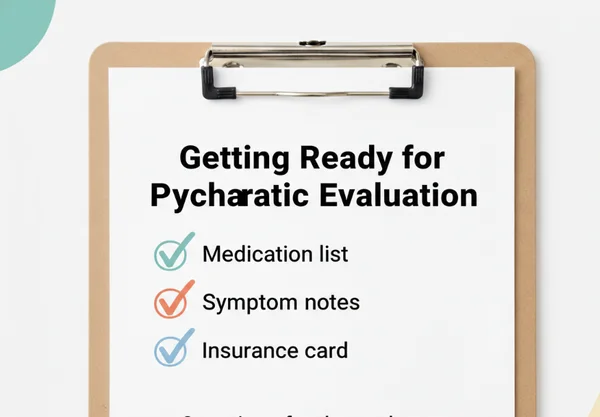
Preparation Checklist: What to Bring and What to Do
Walking in prepared helps both you and the clinician make the most of the session.
Documents to bring:
- Insurance card and photo ID
- List of all current medications (including dosage and frequency)
- Previous psychiatric or psychological evaluation reports
- Relevant medical records (especially for conditions that may affect mental health)
- A written summary of your symptoms, including when they started and how they affect daily life
Before the appointment:
- Write down your top 3–5 concerns and what you most want help with
- Record specific examples of symptoms (frequency, triggers, impact on work or relationships)
- Ask a trusted family member or friend if they are willing to share observations (optional)
- Prepare questions about the evaluation process, diagnosis, and treatment options
- Confirm insurance coverage and any required prior authorization
During the evaluation:
-
Be honest about your experiences — even the difficult ones
-
Ask for clarification if you do not understand a question
-
Take notes or request a summary of findings and next steps
What Happens After the Evaluation?
Once the evaluation is complete, the clinician will share their findings and discuss next steps. This conversation is collaborative — you are an active participant in your treatment plan.
Common outcomes include:
- A formal diagnosis with an explanation of what it means and how it affects you
- A treatment plan that may include therapy (CBT, DBT, exposure therapy), medication, lifestyle changes, or a combination
- Referrals to specialists, support groups, or additional testing if needed
- Follow-up appointments to monitor your response to treatment and adjust the plan over time
If the evaluation does not result in a specific diagnosis, that is still valuable information. It narrows down possibilities and guides the next steps.
When Should You Consider a Psychiatric Evaluation?
You do not need to be in crisis to benefit from a psychiatric evaluation. Consider scheduling one if you experience any of the following:
- Persistent sadness, hopelessness, or emptiness lasting more than two weeks
- Excessive worry or anxiety that interferes with daily activities
- Intrusive, unwanted thoughts or repetitive behaviors you feel unable to control
- Difficulty concentrating, sleeping, or maintaining relationships
- Sudden mood swings or emotional outbursts
- Withdrawal from activities you once enjoyed
- Thoughts of self-harm or suicide
- Substance use that feels out of control
A note on intrusive thoughts and repetitive behaviors: If you notice patterns like compulsive checking, washing, or mental rituals that consume significant time, these may be worth exploring further. An OCD self-screening at OcdTest.net can help you organize your thoughts and identify patterns before speaking with a professional.
This article is for educational and informational purposes only. It is not a substitute for professional medical advice, diagnosis, or treatment. If you are experiencing a mental health crisis, contact the 988 Suicide and Crisis Lifeline (call or text 988) or go to your nearest emergency room.
Your Next Step Toward Understanding
A psychiatric evaluation is one of the most important investments you can make in your well-being. It replaces uncertainty with clarity, and confusion with a concrete plan. Whether you are just beginning to notice changes or have been struggling for years, reaching out to a qualified professional is a sign of strength — not weakness.
If you are not yet ready to schedule a full evaluation, starting with a self-reflection tool can help you build awareness and feel more prepared. Explore the OCD screening tool at OcdTest.net to begin understanding your patterns in a private, low-pressure setting.
Frequently Asked Questions
What does a psychiatric evaluation consist of?
A psychiatric evaluation typically includes a clinical interview about symptoms, medical and family history, a mental status examination, psychosocial assessment, and risk evaluation. The clinician uses this information along with diagnostic criteria (DSM-5-TR) to determine whether a mental health condition is present and recommend treatment.
How long does a psychiatric evaluation take?
Most initial evaluations take 60 to 90 minutes. Comprehensive psychiatric evaluations involving extensive testing or complex cases may require multiple sessions over several weeks, potentially totaling 3 to 8 hours of direct assessment time.
How much does a psychiatric evaluation cost?
Costs range from $20–$75 with insurance (co-pay only) to $200–$500 without insurance for a standard evaluation. Comprehensive assessments with detailed testing can cost $1,500–$3,500. Community clinics and university training programs often offer reduced rates.
What is the difference between a psychiatric and psychological evaluation?
A psychiatric evaluation focuses on diagnosis and medication management, conducted by a psychiatrist or nurse practitioner. A psychological evaluation involves extensive standardized testing of cognition, personality, and behavior, conducted by a psychologist. Both assess mental health but differ in depth and approach.
Can you get a psychiatric evaluation online?
Yes. Many psychiatrists and psychiatric nurse practitioners now offer telehealth evaluations through secure video platforms. Online evaluations follow the same clinical process as in-person sessions and can be an effective, convenient option for initial assessments.
What should I bring to a psychiatric evaluation?
Bring your insurance card, a list of current medications and dosages, any previous evaluation reports or medical records, a written summary of your symptoms and concerns, and a list of questions for the clinician.
Do I need a referral for a psychiatric evaluation?
It depends on your insurance plan. Some plans require a referral from a primary care physician, while others allow self-referral. Check with your insurance provider before scheduling to confirm requirements and coverage.