What Causes OCD? Unraveling Brain, Genetics, and Triggers
If you or a loved one is grappling with obsessive thoughts, the question "Why is this happening?" can feel overwhelming. You might wonder if you did something wrong or if you were born this way. The truth is, scientists have moved away from looking for a single culprit. Instead, what causes OCD is best understood as a "perfect storm" of biological, genetic, and environmental factors coming together.
This guide will break down the science behind the disorder, explaining the role of brain chemistry, family history, and life stressors. We will also clarify the difference between root causes and daily triggers. By the end, you will have a clearer picture of the mechanics behind the symptoms and practical steps to move forward.
What Is the Root Cause? (The "Biopsychosocial" Mix)
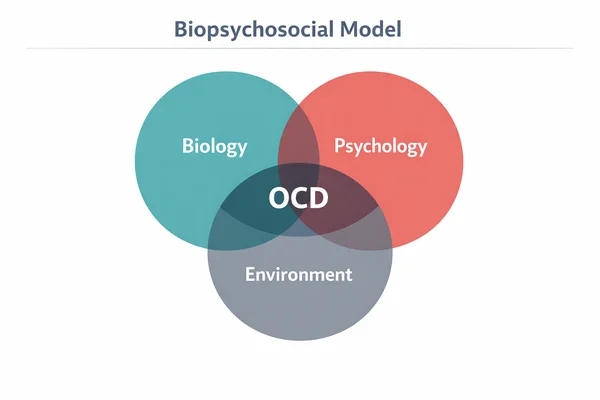
For decades, researchers tried to pinpoint one specific gene or trauma that sparks Obsessive-Compulsive Disorder. However, current medical consensus points to the Biopsychosocial Model. This means there isn't just one root cause of OCD; rather, it is a complex puzzle where three key pieces must fit together.
Think of it like a combination lock. You might have the genetic "hardware" (Biology), but the lock only opens when specific life events (Social/Environment) and thought patterns (Psychology) align.
- Biological: Brain structure and chemistry.
- Psychological: Personality traits like perfectionism or high responsibility.
- Social/Environmental: Trauma, stress, or upbringing.
Understanding this mix helps remove the burden of self-blame. It’s not just "all in your head," nor is it solely because of something that happened to you.
Is OCD a Brain Disorder? (Biological Factors)
One of the most comforting findings for many people is that OCD has a distinct physiological footprint. It is widely considered a brain disorder, meaning there are observable differences in how an OCD brain processes information compared to a non-OCD brain.
The Serotonin Connection: Is It a Chemical Imbalance?
You have likely heard of serotonin, the chemical messenger that helps regulate mood, sleep, and anxiety. Research suggests that what causes OCD in the brain is partly linked to how serotonin is transmitted.
It is not necessarily that you don't have enough serotonin, but rather that your brain's communication system isn't using it effectively. This "chemical glitch" can prevent the brain from moving on from a worry, causing it to replay the same thought over and over.
The Worry Loop: How the Brain Gets Stuck
Deep inside the brain, there is a circuit involving the orbitofrontal cortex (which detects errors) and the basal ganglia (which controls movement and behavior). In a typical brain, when you check if the door is locked, the "error detected" signal turns off once you see the lock is engaged.
In OCD, this communication loop malfunctions. The "error" signal keeps firing even after you have checked. The basal ganglia fails to filter out these repetitive messages, creating a neurological traffic jam.
The Sticky Gear Metaphor: Visualizing the Glitch
Imagine your brain is a bicycle. For most people, shifting gears from "Did I lock the door?" to "What's for dinner?" is smooth. For someone with OCD, the gear shifter gets stuck.
You push and push, but the chain won't move to the next gear. The engine revs (anxiety spikes), but you aren't moving forward. This isn't a lack of willpower; it is a mechanical issue with the bike's gears.

The Genetic Link: Is OCD Genetic
When looking for answers, many people look to their family tree. The question "is OCD genetic?" is common, especially if you see similar traits in a parent or sibling.
Does OCD Run in Families? (Family History)
Studies show that OCD does run in families. If you have a parent or sibling with the disorder, your risk of developing it is higher than the general population. Twin studies have been particularly revealing, showing that if one identical twin has OCD, the other is much more likely to have it too, compared to non-identical twins.
However, genetics are rarely the whole story. Many people with a family history never develop symptoms, and many people with OCD have no known family history.
Genes vs. Destiny: Will I Pass It On?
Having the genetic marker creates a predisposition, not a guarantee. Scientists believe that multiple genes are involved, each contributing a tiny amount of risk.
It is helpful to think of genetics as loading the gun, while the environment pulls the trigger. You might inherit a sensitive nervous system or a tendency toward anxiety, but whether that develops into full-blown OCD often depends on other factors.
Key Takeaway: You inherit vulnerability, not necessarily the disorder itself.
Understanding these causes confirms one major thing: this is a physiological condition, not a character flaw. If you relate to the "sticky gear" metaphor or recognize these loops in your own thinking, checking your symptoms can be a helpful next step.
If you are curious about your own patterns but aren't sure if they fit the clinical picture, our OCD screening tool can help clarify your experience.
Can Stress or Trauma Cause OCD? (Environmental Factors)
While biology loads the gun, life events often pull the trigger. Can stress cause OCD? The answer is a nuanced yes. Stress alone doesn't create the disorder from scratch, but it is a massive activator for those who are already vulnerable.
How Trauma and Life Events Act as Triggers
Significant life changes—even positive ones like a new job, marriage, or the birth of a child—increase responsibility and stress. For someone with a genetic predisposition, this added pressure can cause the brain's "worry system" to overload.
Trauma, such as abuse, loss, or severe accidents, can also be a catalyst. In an attempt to regain control over a chaotic world, the brain might start creating rigid rules or rituals, which eventually morph into OCD symptoms.
Learned Behaviors: Can Anxiety Be "Caught"?
There is also a behavioral component. If a child grows up watching a parent engage in compulsive cleaning or checking, they may learn that these behaviors are necessary for safety. While this isn't a direct "cause" in the biological sense, it models a way of coping with anxiety that can contribute to the disorder's development.

Why Does OCD Get Worse? (Triggers vs. Causes)
It is crucial to distinguish between the root cause (why you have OCD) and triggers (why it is bad right now). Many people ask what causes OCD to get worse suddenly.
Common flare-up triggers include:
- Sleep Deprivation: A tired brain has less ability to filter out intrusive thoughts.
- Illness: Physical sickness puts stress on the body, lowering mental defenses.
- Hormonal Changes: Puberty, pregnancy, and menopause are common times for symptom spikes.
- High Stress: Deadlines, relationship conflict, or financial worry.
Understanding this helps you manage the condition. You can't change your genes, but you can manage your sleep and stress levels.
Specific Causes in Children
Seeing a child struggle with compulsions is frightening for parents. While the causes are largely the same as in adults, there is one specific pediatric trigger that is unique.
PANS/PANDAS: Sudden Symptoms After Strep Throat
In rare cases, a child may wake up "overnight" with severe OCD symptoms following a streptococcal infection (strep throat). This condition is known as PANDAS (Pediatric Autoimmune Neuropsychiatric Disorders Associated with Streptococcal Infections).
Here, the body's immune system attacks the basal ganglia in the brain by mistake. This is a medical infection requiring medical treatment, distinct from the slow-developing OCD seen in most cases.
Is It Just a Phase? Developmental Factors
Children naturally go through phases of ritualistic behavior, like not stepping on cracks or arranging toys perfectly. This helps them feel control as they grow. The difference with OCD is the distress it causes. If the rituals prevent the child from playing or sleeping, it is likely more than just a phase.
Common Myths: What Doesn't Cause OCD
Clearing up misconceptions is just as important as understanding the facts. Here is what research tells us is not to blame.
Is It Caused by "Bad Parenting"?
No. Decades ago, theories blamed "cold" mothers or rigid toilet training. These have been thoroughly debunked. You cannot cause OCD by being too strict or too lenient.
Can You Develop OCD as an Adult? (Adult-Onset)
Yes. While it often starts in childhood, adult-onset OCD is real. It is often triggered by traumatic events, pregnancy (perinatal OCD), or brain injury. It is a myth that you "age out" of the risk zone.
Is It Just About Being Neat?
OCD is not a personality quirk about liking a clean desk. It is a disorder driven by fear and anxiety, not a preference for tidiness.
Next Steps: Do These Causes Match Your Experience?
Now that we have unraveled the biological and environmental threads, the question turns to you. How do these "glitches" show up in your daily life?
How Biological Causes Manifest as Symptoms
The "stuck gear" in the brain manifests as obsessions (intrusive thoughts you can't stop) and compulsions (actions you take to relieve the anxiety). If your brain is constantly signaling "danger," you might find yourself washing hands until they bleed or checking the stove twenty times.
Risk Factor Checklist: Do You Fit the Pattern?
Take a moment to review this list. Do you recognize these factors in your life?
- Family History: Does anyone in your immediate family have anxiety or OCD?
- High Stress/Trauma: Have you experienced a significant stressful event recently?
- "Sticky" Thoughts: Do you find it hard to "switch gears" away from a worry?
- Repetitive Actions: Do you feel driven to perform specific actions to prevent something bad from happening?
If you checked more than two of these boxes, your experiences might align with OCD patterns. Curious to learn more about your specific traits? You don't have to guess. Use our OCD Test tool to explore your traits in a structured, safe way.
Conclusion: Knowledge is the First Step
Understanding what causes OCD is the first step toward managing it. Whether it stems from a genetic predisposition, a chemical imbalance, or environmental stress, the most important takeaway is that it is not your fault.
You are dealing with a complex physiological condition, but it is also one that is highly treatable. By recognizing the roots and identifying your triggers, you can start to reclaim control.
Frequently Asked Questions
Is it caused by a lack of willpower?
No. OCD involves a malfunction in the brain's circuitry. Using willpower to stop OCD is like trying to use willpower to stop an allergic reaction. It requires treatment and strategies, not just "trying harder."
Can the root causes be cured?
Currently, we cannot "cure" the genetic predisposition or change brain structure permanently. However, treatments like ERP therapy and medication can effectively manage symptoms, essentially retelling the brain how to process the "error" signals.
Is OCD related to autism?
There is a genetic overlap, and the two conditions often occur together (comorbidity). However, the root motivations are different. OCD rituals are usually driven by fear, while autistic repetitive behaviors are often driven by sensory needs or enjoyment.
Why did my symptoms worsen suddenly?
Sudden flare-ups are usually linked to "triggers" rather than a change in the root cause. Look for recent stressors, lack of sleep, illness, or medication changes that might be lowering your resistance to intrusive thoughts.